
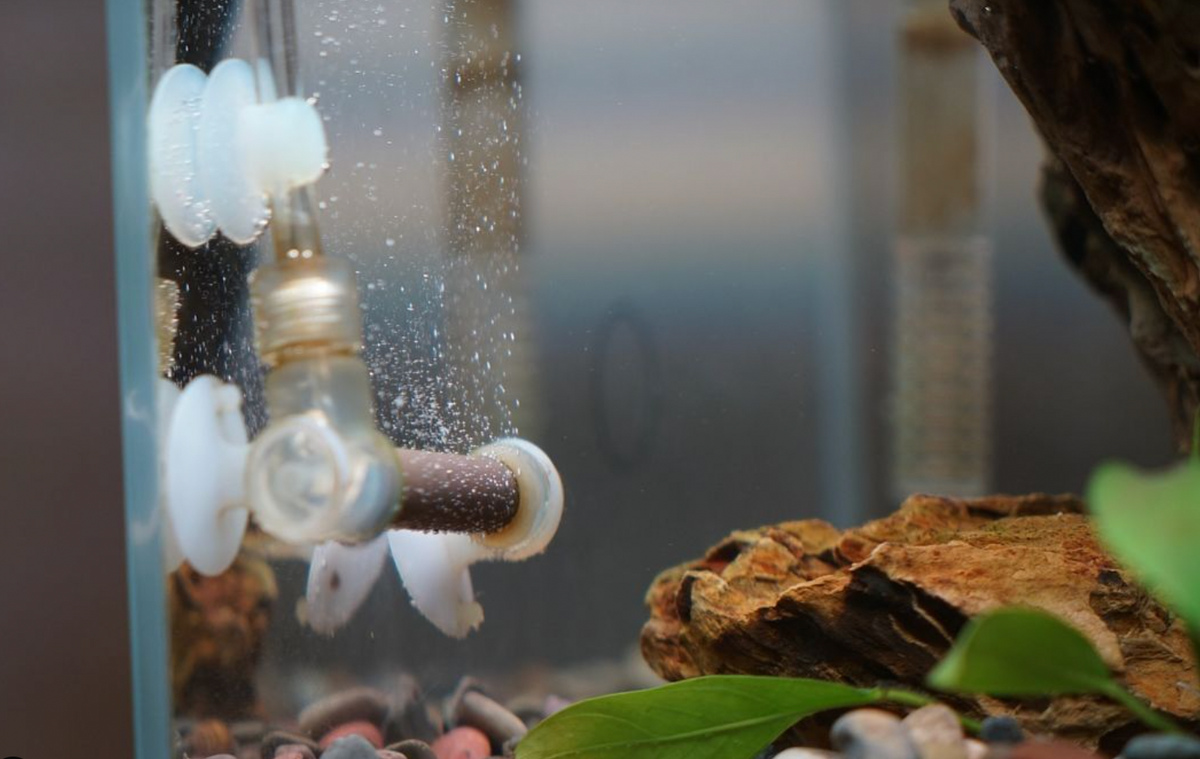
Bad CO2 bubbles are coarse, lazy bubbles that leave the diffuser and climb straight to the surface instead of breaking into a fine mist that drifts through the tank. Nearly always the cause is one of three things: a clogged ceramic membrane, too little working pressure behind it, or a diffuser placed where the flow cannot carry the mist to your plants. Each one has a quick test and a simple fix.
What do bad CO2 bubbles look like?
Good diffusion looks like haze. The bubbles leaving a healthy ceramic membrane are small enough that the tank's current catches them, carries them over the leaves and shrinks them visibly on the way up. Many never reach the surface at all, because they dissolve first. That is the whole job of a diffuser: it turns a gas stream into surface area the water can absorb.
Bad bubbles behave like bubbles from an air stone. They are large, they rise in a straight column beside the glass, they arrive at the top the same size they left the ceramic, and they burst audibly. Gas that reaches the surface intact has done nothing for your plants; it has only emptied your cylinder. If the haze disappears the moment you look away from the diffuser, the CO2 is leaving the water faster than the plants can use it.
- Fat, round bubbles instead of a fine white haze
- A single stream rising straight up rather than drifting with the flow
- Bubbles that pop at the surface unchanged in size
- Gas escaping from the diffuser's rim or a tubing joint rather than the ceramic face
- Cloudy or slimy water right at the diffuser face
- A bubble rate you have had to keep raising, with no change in plant growth
Why is my CO2 diffuser making big bubbles instead of mist?
A ceramic diffuser is a pressure device. Gas only breaks into mist when it is forced through pores narrower than any bubble you can see, so anything that lowers that pressure or widens that path gives you big bubbles instead.
A clogged ceramic membrane
Biofilm, algae and mineral scale settle in the pores and close them one by one. Our guide to CO2 diffuser cleaning lists the signs: fewer bubbles than the needle valve is set for, bubbles that look larger or irregular, cloudy water at the face, and a changed reading on the regulator's working pressure gauge. A soak in a mild acid such as vinegar or citric acid reopens the pores, and the rinse afterwards matters more than any scrubbing, because the membrane is brittle and a scratched disc never mists evenly again.
Not enough working pressure
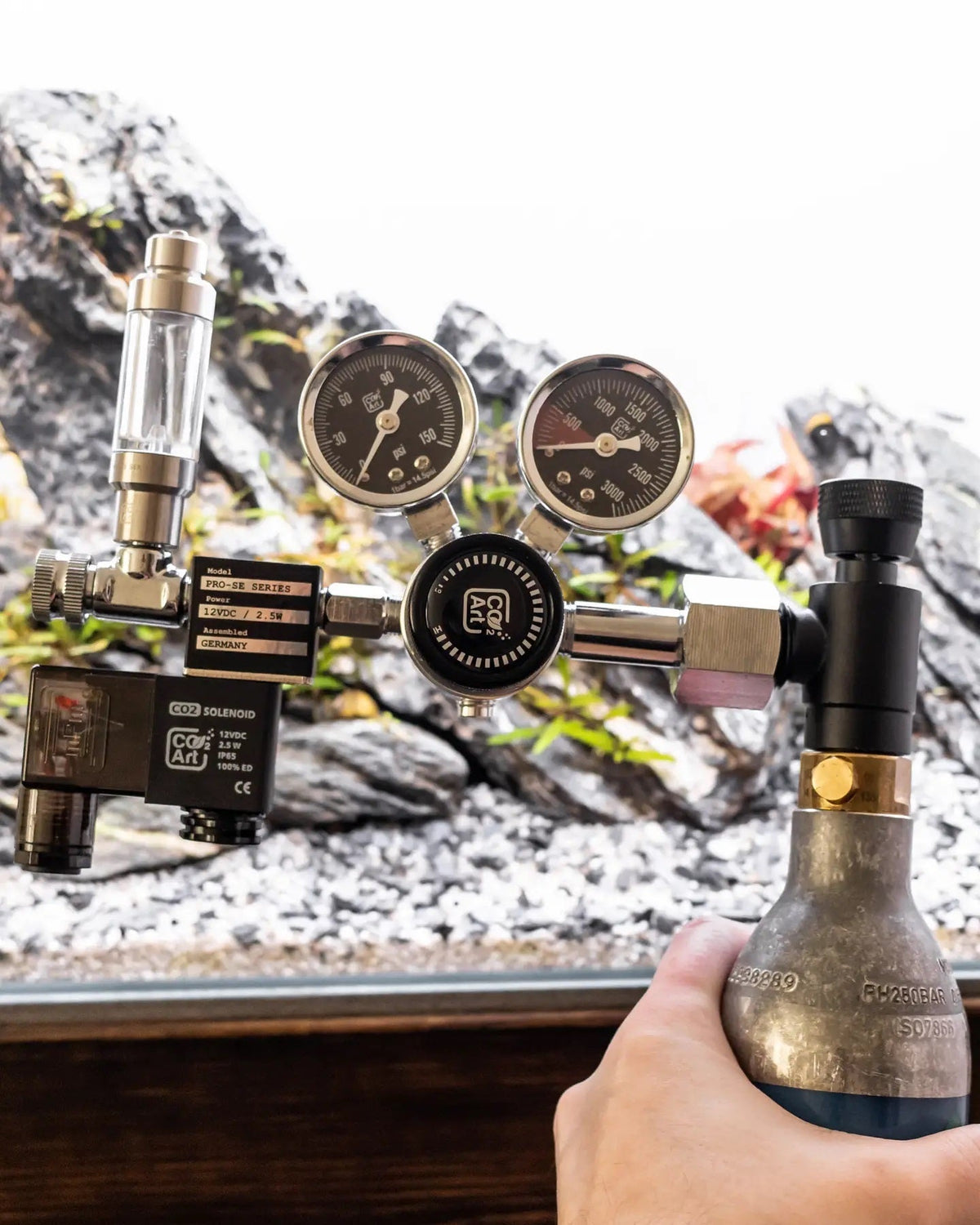
Below the pressure a membrane is rated for, gas collects behind the ceramic and escapes as occasional fat bubbles, or stops altogether. Inline units are the strictest about this: the minimum working pressure for our inline atomizer is stated on its product page — 30 PSI. Raise the working pressure on a dual stage regulator in small steps, then set the bubble rate again, because the needle valve downstream will pass more gas once the pressure behind it is higher.
A worn membrane or a leaking seal
Ceramic wears out. Once the disc is cracked, or the o-ring between the disc and its housing is flattened, gas takes the easy path and comes out in lumps, usually from the rim rather than the face. Look closely at where the bubbles are born: the face of the ceramic means the membrane is still working, the edge means the seal is not. Many diffusers take a replacement membrane, which is the cheaper repair.
Why the mist isn't reaching your plants
A diffuser cannot distribute anything by itself. The bubbles go where the water goes, so your circulation decides whether the mist crosses the plants or slides up the back glass. The classic mistake is a diffuser in a quiet corner: the CO2 rises in a tidy column, hits the surface and leaves, while the far end of the tank never sees it.
Put the diffuser where the flow will take it
Mount it low, either on the opposite side of the tank from the filter outflow or directly under the outflow, so the current chops the mist and drives it along the length of the aquarium. What you want to see is haze reaching the far corner within a few seconds and leaves that visibly stir. If the column goes straight up, the diffuser is in dead water, however good the ceramic is.
Check your surface agitation
Strong surface movement drives dissolved CO2 back out as fast as the diffuser puts it in, and that reads at the plants as a diffuser problem. If an air stone runs while the CO2 is on, the two are working against each other; many planted tanks run the air stone at night instead. Lower the outflow spray bar, or angle it along the surface rather than into it, and watch whether the drop checker colour changes over the following day.
Look for the dead spots
Tall hardscape, a dense carpet and an undersized pump all create pockets the mist never enters, and the plants there behave as if no CO2 is injected at all. Stand in front of the tank and follow the haze: anywhere it does not go is a place you will see stunted new growth and algae first. A small circulation pump aimed along the front glass often does more for those plants than a higher bubble rate.
| What you see | Likely cause | What to check | What to do |
|---|---|---|---|
| Fat bubbles from the ceramic face | Clogged pores, or working pressure too low | The working pressure gauge, and how long since the disc was cleaned | Soak the ceramic in a mild acid, then raise working pressure in small steps |
| Bubbles from the rim or a tubing joint | Flattened o-ring or a loose fitting | The seal between the disc and its housing | Refit or replace the seal, and use pressure-rated CO2 tubing |
| Fine mist that rises straight up and leaves | Diffuser sitting out of the flow | Where the haze travels in the first few seconds | Move it low, opposite the filter outflow or directly under it |
| Mist on one side only, weak growth on the other | Dead spots and weak circulation | Leaf movement at the far end of the tank | Add or re-aim a circulation pump along the glass |
| Bubbles look fine but plants are unchanged | CO2 lost at the surface, or the rate is simply too low | Drop checker colour against its reference solution | Reduce surface agitation while the lights are on, then adjust the rate slowly |
| Very few bubbles for the needle valve setting | A heavily clogged or worn membrane | Whether a cleaned disc recovers its old rate | Replace the ceramic membrane |
How to fix bad diffuser bubbles, in order
Work through these in sequence and stop when the haze comes back. Changing two things at once is how people end up replacing a diffuser that was only dirty.
- Watch where the bubbles are born — the ceramic face, or the rim and the tubing joint. A leak is a seal to refit, not a cleaning job.
- Soak the ceramic in a mild acid, rinse it thoroughly and refit it, following our cleaning guide.
- Check the working pressure before you touch the needle valve. Pressure decides bubble size; the needle valve only decides bubble rate.
- Replace the membrane if a cleaned disc still bubbles coarsely, rather than raising the gas to compensate.
- Re-site the diffuser low and in the flow, then follow the haze to the far end of the tank.
- Reset the rate for your aquarium using our guide to how many bubbles per second a planted tank needs, and change it slowly.
- Confirm the result in the water rather than at the diffuser, with an aquarium CO2 drop checker placed well away from the mist stream.
- Leave a day or two between changes, so you are reading the plants and not your last adjustment.
When to take the bubbles out of the tank: inline atomizer or reactor
If you run a canister filter, the simplest cure for visible bubbles is to stop making them inside the aquarium. An inline CO2 atomizer fits on the filter hose and shears the gas into a mist that enters with the returning water, already spread across the flow. It asks for more than an in-tank disc does: pressure-rated CO2 tubing rather than silicone, a higher minimum working pressure, and a membrane you replace when it stops misting.
A reactor goes further and dissolves the gas completely, so nothing visible enters the tank at all. Our comparison of reactors and diffusers is honest about the trade: a reactor is quieter to look at and tends to suit larger aquariums, while a diffuser is compact, cheaper and easier to install, and in-tank and inline diffusers grow plants equally well. Choose by what you are willing to see in the water, by your filter, and by the pressure your regulator can hold.
How to tell whether the CO2 is really dissolving
The diffuser is not the measurement. A drop checker filled with reference solution, hung away from the mist, tells you what the water is actually holding a few hours later, and its colour against that reference is the reading that matters — not the bubbles you can count. The plants give you the second reading: steady new growth, and pearling late in the lit period, mean the carbon is arriving where it is needed.
Raise CO2 slowly and watch the animals in the tank while you do. Dissolved CO2 forms carbonic acid and lowers pH, and it will stress livestock long before the plants complain. If you find yourself pushing the rate to the point where fish hang at the surface, the problem is almost never the amount of gas — it is distribution or dissolution, which is what everything above is about.

Frequently asked questions
Should CO2 bubbles reach the surface of the tank?
A few will, but most should vanish on the way up. Bubbles that arrive at the surface the same size they left the diffuser have given nothing to the plants. If you can follow a steady column from the ceramic to the top, the mist needs more flow to carry it, smaller bubbles, or both.
How do I know if my CO2 diffuser is clogged?
Judge it against a setting you have not changed. A clogged ceramic passes fewer bubbles, makes them larger or irregular, shifts the reading on the working pressure gauge, and often looks cloudy at the face. If a soak in a mild acid restores the old rate, clogging was the cause.
Why are my plants not growing even though the diffuser is bubbling?
Bubbling is not dissolving. The gas may be rising straight out at the surface, missing half the tank, or being driven back out by strong surface movement. Check with a drop checker placed away from the mist, and fix distribution before you raise the bubble rate.
Can a CO2 diffuser be too large for my tank?
In practice, yes. A large ceramic area needs enough gas and enough pressure to mist evenly across the whole disc; fed too little, it bubbles unevenly from a few spots. Match the diffuser to the tank and to the pressure your regulator holds, not to the biggest disc that fits.
Does cleaning a CO2 diffuser with bleach damage it?
It can, and the residue is the bigger risk. Our cleaning guide prefers a mild acid such as vinegar or citric acid, keeps chlorine for stubborn deposits only, and insists on a thorough rinse, because anything left on the ceramic goes into the tank with the next bubble.
If a cleaned disc still bubbles coarsely, or the mist never had a chance in your tank, our CO2 diffusers cover both in-tank and inline options to suit your filter.
Share:
Best CO2 Regulator for a Planted Aquarium: A Buying Guide