
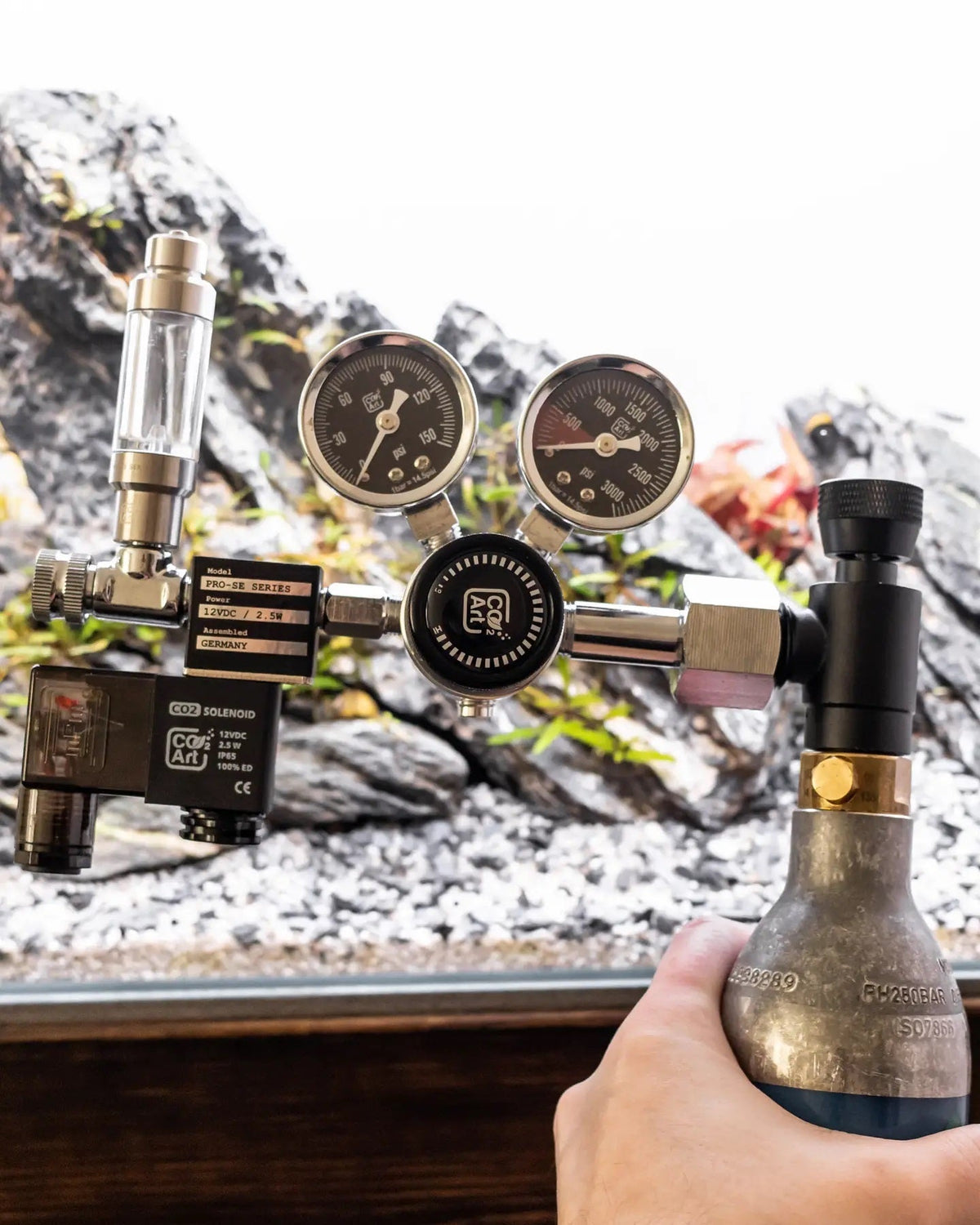
The best CO2 regulator for a planted aquarium is a dual stage unit with an integrated solenoid, a needle valve fine enough to hold a slow bubble count, two gauges, and a thread that matches the cylinder you can refill locally. Dual stage control is the part that matters most: it holds the working pressure steady as the cylinder empties, so the tank is not hit by a sudden dose at the end of a cylinder.

What makes the best CO2 regulator for a planted aquarium?
A regulator is a pressure device you will own for years, and almost every buying decision comes down to a short checklist. Work through it with the listing open and you will not be surprised after the box arrives.
Nothing on that list is exotic, and none of it is about the badge. A plain regulator that controls pressure in two stages and takes your cylinder will serve a planted tank better than a handsome one that does neither.
- Dual stage pressure control — the output stays level as the cylinder empties, which is what prevents an end-of-tank dump.
- An integrated solenoid — a plug-in timer can stop the gas when the lights go out, without you standing over the tank.
- A fine needle valve with a bubble counter — you need small, repeatable adjustments, not a tap.
- Two gauges — one for what is left in the cylinder, one for the working pressure reaching the diffuser.
- The right thread for your cylinder — in North America that is CGA320; Europe and the UK use their own standards, commonly known as BS341/DIN477/W21.8x14.
- Parts, servicing and a warranty you can read — ask whether seals and the solenoid coil can be replaced before you need one.
Single stage or dual stage: which do you need?
A single stage regulator drops cylinder pressure to working pressure in one step, and that step shifts as the cylinder empties. Towards the end of a cylinder the output can creep up, and the bubble rate climbs with it — the end-of-tank dump that planted-tank keepers warn each other about. A dual stage regulator does the same job in two steps, so the second stage sees a steadier input and the output holds.
That is why every regulator we build is dual stage, and why we would not recommend a single stage one for a planted tank at any price. If you already own a single stage regulator, the practical defences are a timer, a drop checker you actually look at, and swapping the cylinder before it runs dry rather than squeezing the last of it. Our older piece on what a CO2 regulator does walks through the same parts in more detail.
Why stability matters more on a small tank
On a small aquarium the dose is small, so a pressure drift that would be harmless in a big tank is a real swing in the water. Stability matters more, not less, as the tank gets smaller. The same logic applies to shrimp tanks, where the margin between enough CO2 and too much is thin and the first sign of trouble is usually the last one you get.
Does a CO2 regulator need a solenoid?
A solenoid is an electrically operated valve that opens when it has power and closes when it does not. Put it on the same plug timer as your lights and the gas runs only while the plants can use it. CO2 does nothing for a dark tank, so shutting it off overnight saves gas and keeps the night-time swing smaller.
Buying a regulator with the solenoid built in is simpler than adding one later: one body, one seal, one thing to fail. Our Pro SE series dual stage regulator ships with the solenoid integrated, a needle valve and bubble counter on the body, a check valve, and a universal power adapter, so it runs on either side of the Atlantic.

Two details are worth checking on any solenoid, whoever made it: that it stays cool enough to touch in normal use, and that a replacement coil is available. A solenoid cycles every day of its life, so it is the part most likely to need attention first.
Will the regulator fit your CO2 cylinder?
This is the question behind most disappointed first orders, and it has nothing to do with the regulator's quality. Cylinder valve threads are regional. In North America the standard on a refillable CO2 cylinder is CGA320, and our regulators are built for it; Europe and the UK use their own thread standards, so a regulator bought for one market needs the matching adapter in another.
Then decide where the gas will come from. A refillable cylinder from a welding or beverage gas supplier is the cheapest way to run a planted tank over time, and a larger cylinder means longer between trips. If you have nowhere to refill, or the tank is small, a paintball or SodaStream adapter lets the same regulator run from cartridges you can buy anywhere, at the cost of changing them more often.
Ask your supplier what they fill before you buy the cylinder, not after. Ask also whether the cylinder is in test: cylinders must be requalified periodically and a filler will refuse one that is out of date. The interval is set by regulation where you live — typically every five years for standard refillable CO₂ cylinders in the United States — and the shop that fills it will tell you.
Regulator on its own, or a complete CO2 system?
A regulator is one link in a chain: cylinder, regulator, tubing, check valve, diffuser, drop checker. Buying the parts separately is sensible when you already own some of them, and it is also how people end up with a mismatched thread, airline that CO2 slowly degrades, or no way to see what the water is doing.
A complete kit arrives matched. Ours pair the regulator with an aluminium bubble counter, CO2-resistant tubing, a drop checker with indicator solution, and a diffuser. Choose the diffuser by your filter: an inline diffuser sits in the hose of an external canister filter and keeps the inside of the tank clear, while an in-tank diffuser is the one to pick if your filter is internal or hangs on the back.
If a second tank is likely later, check whether the regulator takes a manifold block. The Pro Elite body does, which means one cylinder and one regulator can feed more than one aquarium instead of buying the whole chain twice.
| Regulator | Who it suits | Pressure control | What comes with it | Expandable? | Price band |
|---|---|---|---|---|---|
| Pro SE series dual stage with integrated solenoid | Most planted aquariums, and a first serious regulator | Dual stage; working pressure adjustable up to 40 psi | Solenoid, needle valve, bubble counter, check valve, universal power adapter | No manifold block | $149.99 |
| Pro Elite series dual stage with solenoid | Several tanks off one cylinder, or the steadiest bubble count available | Dual stage, higher ceiling and tighter stability — to 1 psi | Solenoid, precision needle valve, bubble counter, stainless gauges, check valve | Yes, extendable manifold block | $269.99 |
| Complete CO2 system (regulator plus the rest of the chain) | Starting from nothing, in one order, with nothing mismatched | Dual stage, as the regulator in the kit | Regulator, bubble counter, diffuser, drop checker and solution, CO2-resistant tubing | Depends on the regulator in the kit | From $209.95 |
| Paintball or SodaStream adapter to use with one of the regulators above | No refill supplier nearby, or a small tank | Unchanged — the adapter only changes where the gas comes from | The adapter alone; cylinder and regulator are separate | No | $28.99 |
How to set a new regulator up without flooding the tank with CO2
Fit the regulator to the cylinder dry, hand-tight on its washer and tighten with a wrench. Next, open the cylinder valve slowly, and check the joint with soapy water before anything goes near the aquarium. Then set the working pressure your diffuser needs — CO2Art diffuser 40-50 psi, as stated in its listings — with the needle valve closed, and open the needle valve a fraction at a time.
Start the bubble rate lower than you think you need and raise it over days rather than hours. A drop checker with indicator solution is the cheap way to see whether the water has too much gas or too little; it lags behind the tank by hours, which is exactly why you change one thing a day and wait. Watch the fish at the end of the photoperiod, when dissolved CO2 is at its highest.

Put the solenoid on a timer that starts before the lights and stops before they go out, and keep a check valve between the regulator and the tank so water cannot siphon back while the gas is off.
What buyers regret, and the questions to ask before you pay
The regrets we hear in support are almost never that a regulator was too plain. They are about the part that was left out, or the thread nobody checked.
- A single stage regulator bought on price, then a fish loss at the end of a cylinder.
- The wrong thread, discovered on a Sunday with a full cylinder and no adapter.
- No solenoid, so the gas runs all night or gets turned by hand and forgotten.
- A needle valve too coarse to hold a slow rate, so the bubble count drifts every day.
- No check valve, so water reaches the regulator body and ends its life.
- A warranty with nobody behind it — ask who services the regulator and whether spares exist.
Frequently asked questions
What is the best CO2 regulator for a planted aquarium?
A dual stage regulator with an integrated solenoid, a fine needle valve with a bubble counter, two gauges and the thread your local cylinders use. Dual stage control is the part that protects the tank, because the output pressure stays level as the cylinder empties instead of climbing at the end.
Do I really need a dual stage CO2 regulator?
For a planted tank, yes. A single stage regulator can let the output pressure rise as the cylinder empties, which raises the bubble rate without anyone touching the needle valve. Every regulator we sell is dual stage for that reason. If you own a single stage one, change the cylinder before it runs dry.
Can I run a CO2 regulator from a paintball or SodaStream cylinder?
Yes, with the right adapter, and it is the sensible route when no local supplier refills CO2 cylinders or the tank is small. Expect to change cartridges more often than you would refill a full-size cylinder, and keep the same habits: solenoid on a timer, slow bubble rate, drop checker in the tank.
Does a CO2 regulator come with a bubble counter and check valve?
Ours do: the needle valve, bubble counter and check valve are on the regulator body, and a universal power adapter for the solenoid is in the box. Check the listing of any regulator you are comparing, because several brands sell those parts separately and adding them later is rarely cheap.
How long does a CO2 cylinder last on a planted tank?
It depends on the cylinder size, the bubble rate and how many hours a day the solenoid is open, so a single figure is wrong for most tanks — using a 2.5-pound bottle in a few weeks is a fair estimate for the tank size of 20 gallons. A larger cylinder costs less per refill and means fewer trips to the supplier.
When you are ready to compare the real figures side by side, open our CO2 regulators and read the working pressure, the warranty term and the box contents on each listing.
Sources
- Compressed Gas Association — CGA V-1, standard for cylinder valve outlet and inlet connections
- U.S. DOT cylinder requalification rules, 49 CFR part 180 subpart C (eCFR)
- Diana Walstad, Ecology of the Planted Aquarium
- The Barr Report (Tom Barr) — planted-tank CO2 and end-of-tank-dump discussions
- Our own product listings for the Pro SE and Pro Elite regulators
Share:
Carpeting Plants for Aquariums: What Grows and What CO2 They Need