
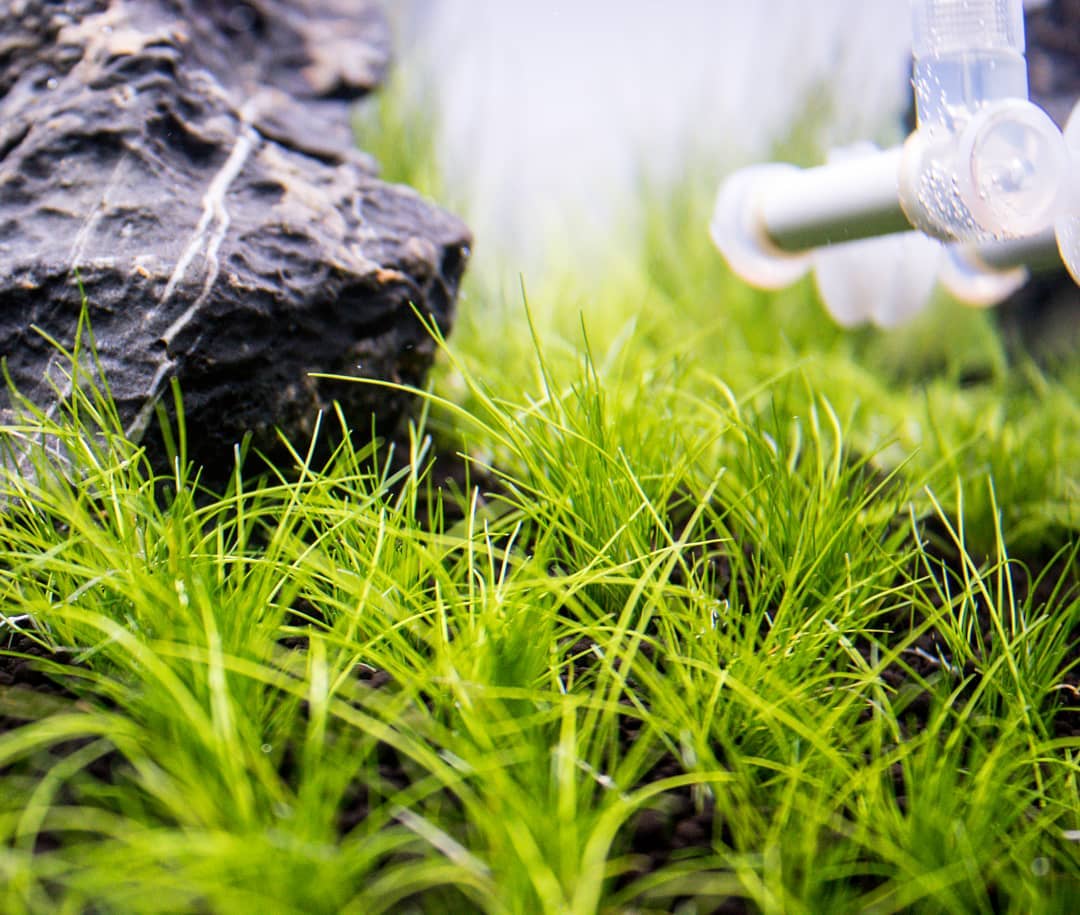
Carpeting plants are low-growing aquarium plants that spread sideways across the substrate by runners or creeping stems until they cover it like a lawn. Some, such as dwarf sagittaria, Marsilea and Cryptocoryne parva, fill in slowly without injected CO2. The tight, flat carpets most people picture — Monte Carlo, dwarf baby tears, Glossostigma, hairgrass — need strong light and added CO2 to stay compact and green.

What are carpeting plants in an aquarium?
A carpeting plant is any aquarium plant that stays short and grows outwards instead of upwards. Most spread in one of three ways: runners that travel under the substrate and push up new shoots, creeping stems that lie flat and root wherever they touch, or mosses tied to mesh that thicken in place. What they share is a habit of covering ground rather than reaching for the light, which is why they go in the foreground and along the open middle of a tank.
A finished carpet does more than look tidy. It hides the substrate line and makes a small tank read as deeper than it is, it holds fine substrate where flow would otherwise stir it, and it takes up nutrients algae would use. Shrimp and small fish graze and shelter in it. The trade-off is maintenance: a carpet is the plant you trim most often, because the moment it grows in layers the lower leaves are shaded and begin to rot.
Do carpeting plants need CO2?
It depends on the plant, and it depends on your light. Light sets how fast a plant wants to grow; carbon is what it grows from. Under modest light, slow carpets such as Marsilea, dwarf sagittaria and Cryptocoryne parva will fill in without injected CO2 — they simply take their time, and they tend to grow a little taller and looser. Under strong light the same tank without added CO2 is where algae wins, because the plants cannot use the light they are given.

The tight, flat lawns are a different matter. Monte Carlo, dwarf baby tears, Glossostigma and a dense hairgrass lawn are grown with injected CO2 in almost every tank you see them in. With CO2 they stay compact, root quickly and close up in weeks rather than months; without it they creep upward towards the light or thin out from the bottom. A drop checker hung in the tank is the cheap way to see whether the level holds while the lights are on: blue means too little, green is the working range, yellow is too much.
| Plant | Light it wants | Added CO2 | How it spreads | Good for |
|---|---|---|---|---|
| Monte Carlo (Micranthemum tweediei) | Medium to high | Strongly helps | Creeping stems that root as they go | A first flat carpet |
| Dwarf baby tears (Hemianthus callitrichoides 'Cuba') | High | Practically needed | Tight mats of tiny leaves | Show tanks, patient aquascapers |
| Dwarf hairgrass (Eleocharis parvula) | Medium to high | Strongly helps | Runners under the substrate | A grass-like lawn |
| Glossostigma elatinoides | High | Practically needed | Fast creeping stems | Competition-style scapes |
| Marsilea hirsuta | Low to medium | Optional | Slow runners, clover-like leaves | Low-tech tanks |
| Dwarf sagittaria (Sagittaria subulata) | Low to medium | Optional | Runners; taller in dim light | Easy, forgiving lawns |
| Cryptocoryne parva | Low to medium | Optional | Very slow, clumping | Shade and patience |
| Staurogyne repens | Medium | Helpful | Low bushy stems, needs trimming | A leafy foreground |
| Hydrocotyle tripartita 'Japan' | Medium | Helpful | Rambling stems, grows every which way | Fast cover, heavy trimming |
| Christmas moss on mesh | Low to medium | Optional | Attaches and thickens, does not root | Hardscape-heavy tanks, no substrate |
Which carpeting plants are easiest for a first try?
If this is your first carpet, pick a plant with larger leaves and a forgiving temper. Bigger leaves mean fewer portions to place, faster visible progress and less melting when the plant switches from the grower's humid trays to life underwater. The ones below reward patience rather than punishing mistakes.
Leave dwarf baby tears and Glossostigma until a CO2 system is running steadily. They are not difficult plants once the conditions are right, but they are unforgiving of what a new planted tank gets wrong: a gap in the injection, a shaded corner, a filter whose output never reaches the front glass.
- Monte Carlo (Micranthemum tweediei) — rounded leaves, roots fast, forms a flat mat; happiest with added CO2 but will grow without it.
- Dwarf sagittaria (Sagittaria subulata) — sends out runners in almost any tank; taller in dim light, shorter and denser as light increases.
- Marsilea hirsuta — clover-shaped leaves, slow and undemanding, one of the few true carpets that suits a low-tech tank.
- Staurogyne repens — a low bushy stem plant rather than a runner; trim the tops and it branches sideways into a leafy foreground.
- Christmas moss on stainless mesh — no substrate needed, sits on hardscape or over sand, and can be lifted out to trim.
How do you plant a carpet so it spreads?
Divide, then space. A single pot or tissue-culture cup covers a surprising area if you split it into small portions of a few stems or a single runner each and plant them across the bed with tweezers rather than in one clump. Portions planted apart grow towards each other and knit; a clump stays a clump and shades its own middle. Push each portion in far enough that it stays put when the flow hits it, with the crown sitting at the surface of the substrate rather than buried.
Two practical points before you start. Rinse tissue-culture plants to get the gel off, or it clouds the water and feeds bacteria. And give the front of the tank a substrate layer deep enough for runners to travel through — the depth to confirm for the species you chose is about 3-4 cm — with a fine grain, because runners cannot cross coarse gravel.
Dry start or plant underwater?
The dry start method — planting into wet substrate, sealing the tank with film and letting the carpet establish in humid air before flooding — trades a wait for a head start: the plants grow in air with all the carbon they can use and no algae competing with them. It suits Monte Carlo, dwarf baby tears and Glossostigma. Plant underwater instead if you want the tank running now, or if your carpet is a moss or a runner species that moves to submerged growth easily.
Trimming while it fills in
Trim early and trim often. Cutting the tops of a creeping carpet makes it branch sideways instead of climbing, and the trimmings replant straight into any bare patch. Net the floating pieces out afterwards — left in, they rot into the substrate and settle on the leaves. Once the carpet is thick, thinning it down to the substrate in strips every 3 weeks keeps light reaching the base and stops the mat lifting.
What CO2 setup does a carpeted tank need?
A carpet sits furthest from the surface and closest to the substrate, so it is the first thing to suffer when injection is unsteady. Three pieces do the work: a regulator that holds its output as the cylinder empties, a needle valve fine enough to set a slow rate and keep it, and a diffuser that breaks the gas up small enough to dissolve before it leaves the tank. A dual-stage regulator with an integrated solenoid covers the first two and lets a timer switch the gas with the lights, so nothing is injected at night when the plants cannot use it.
Set it low and raise it slowly. Start at a rate you can count — the figure to take from your system's own guidance for the tank size is one bubble per second* — then give the tank a day or two at each step and read the drop checker in the afternoon rather than the morning. Watch the livestock while you do it: fish hanging at the surface means the level has gone too far, and the answer is less gas and more surface movement, not a bigger diffuser.
Inline or in-tank diffuser?
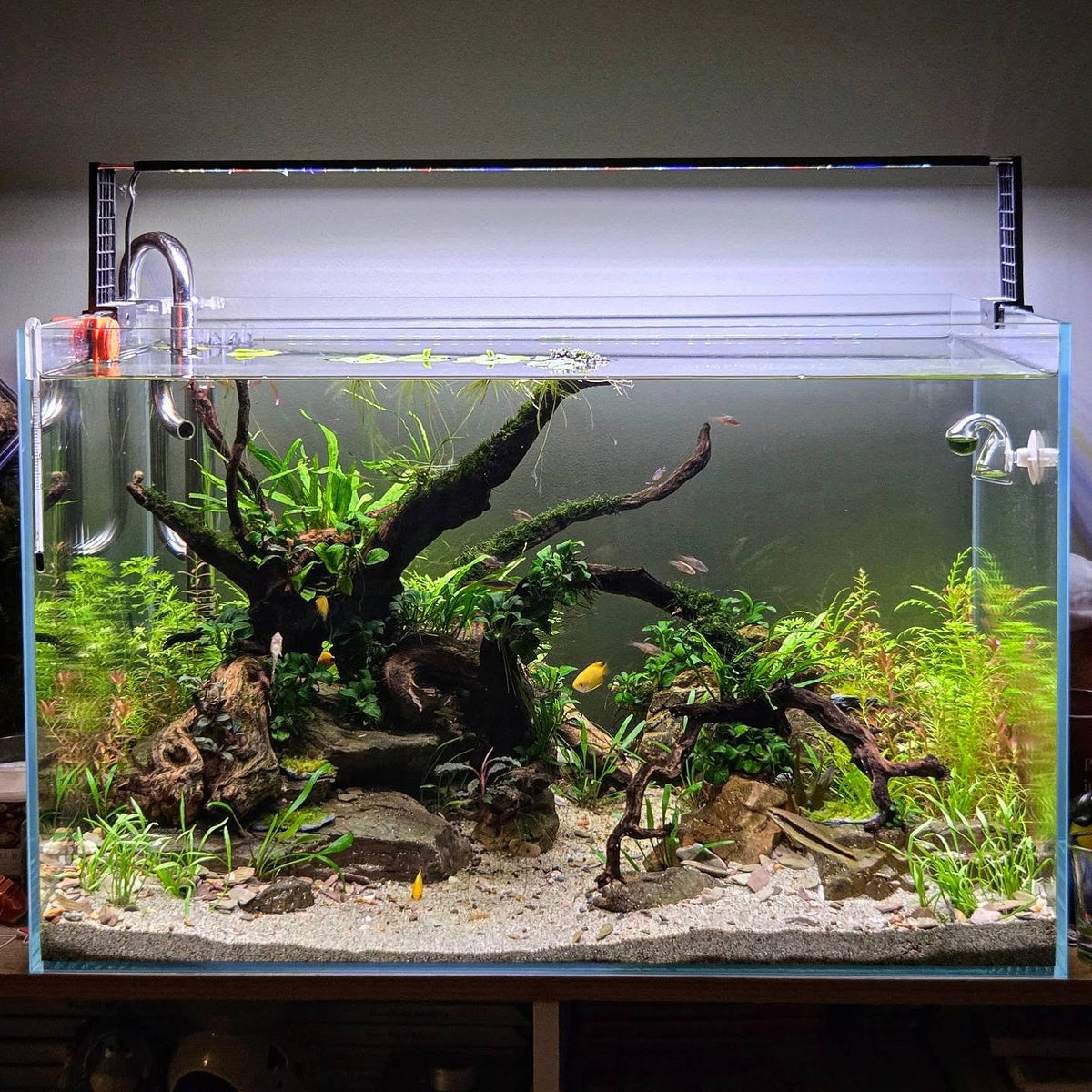
If you run a canister filter, an inline diffuser sits on the hose outside the tank and keeps hardware out of the aquascape, which matters when the foreground is the thing you are showing off. If you do not, an in-tank Flux diffuser mounts on the glass with suction cups and pushes a mist the flow can carry forward. Either way, use tubing rated for CO2 pressure, and expect the ceramic membrane to need cleaning or replacing as it clogs. Both types state a working pressure they need to mist properly, so check the figure for yours.

Why carpets go patchy, and how to fix it
Almost every carpet goes through an ugly phase in its first weeks, and most of the causes look alike from above. Work through them in this order.
- Leaves melting right after planting — normal for tissue-culture and emersed-grown plants. The sign it is going well is small new leaves appearing at the base while the old ones go, so keep the water clean and uproot nothing.
- Growing upward instead of sideways — not enough light reaching the substrate, usually because stem plants behind have grown over the foreground. Trim what shades it before changing anything else.
- The mat lifting away in sheets — old growth underneath has died and gassed off. Thin it in strips, replant the healthy pieces, and trim more often from then on.
- Algae on the leaves themselves — an unstable CO2 level, or a lighting period longer than the plants can use. Shorten the lights to 1 hour less and steady the injection before reaching for a chemical.
- Pale, thin hairgrass — a feeding problem more often than a carbon one. It is a hungry plant, and the substrate under a mature carpet runs out.
- Dead patches in one spot only — flow. Follow where the filter output actually goes; a carpet dies where mist and nutrients never arrive.
Frequently asked questions
How long do carpeting plants take to fill in?
With strong light, injected CO2 and regular trimming, a fast species like Monte Carlo or Glossostigma closes up in weeks. The same plants in a low-tech tank, or slow growers such as Marsilea and Cryptocoryne parva, take months. Trimming and replanting the pieces speeds it up more than feeding does.
Can you grow a carpet without injected CO2?
Yes, if you choose the plant for the tank rather than the other way round. Marsilea hirsuta, dwarf sagittaria, Cryptocoryne parva and mosses on mesh all carpet without added CO2 under modest light. Expect a looser, taller cover and a much slower fill-in, and keep the lighting period short so algae does not take the surplus.
What substrate do carpeting plants need?
A fine-grained substrate, deep enough at the front for runners to travel and roots to hold; the depth to confirm for your species is around 3-4 cm. Coarse gravel is the common mistake, because runners cannot cross it. Nutrient soils help, and root tabs pushed under a mature carpet answer the feeding problem that shows up later.
Do carpeting plants need high light?
Light sets the pace, not the possibility. The dense lawns want strong light, and strong light only works when CO2 and nutrients keep up; otherwise the surplus goes to algae. Under modest light, choose a slow carpet and accept a slower, slightly taller result.
How do you stop a carpet from lifting off the substrate?
Lifting means dead growth underneath. Thin the mat down to the substrate in strips rather than shaving the top, replant healthy portions into the gaps, and trim on a schedule from then on. Keeping the filter output from blasting one spot helps the pieces stay rooted while they knit.
When you are ready to give a carpet the carbon it needs, our complete CO2 kits pair a dual-stage regulator with either an inline or an in-tank diffuser, so the choice comes down to whether you run a canister filter.
Sources
- Tropica Aquarium Plants — plant catalogue and care labels
- Flowgrow aquatic plant database
- UF/IFAS Center for Aquatic and Invasive Plants
- USGS Nonindigenous Aquatic Species database
- Our own product pages for the figures marked with an asterisk (*)
Share:
CO2 System for 20 Gallon Aquarium and Up: A Sizing Guide