

A CO2 reactor dissolves gas outside the tank: it traps incoming CO2 in a chamber on your canister filter's outflow and holds it against moving water until there is nothing left to see. The pros are near-complete dissolution, no mist in the display and no ceramic to clog. The cons are lost flow, trapped gas that gurgles, extra plumbing, and no bubbles to tell you it is working.
What is a CO2 reactor and how does it work?
A CO2 reactor is a sealed chamber plumbed into the return line of a canister filter, or onto a small pump of its own. Gas from the regulator is fed into the top of the chamber, where baffles, a spiral path or a bed of media slow the water down and keep the gas tumbling in it. The gas stays in there until it has dissolved, so the water going back into the tank carries carbon in solution instead of as bubbles. Nothing is released into the display.
A diffuser does the same job the other way round: it forces CO2 through a ceramic membrane and releases a fine mist into the tank, and the mist dissolves on its way through the water. Our side-by-side write-up on how a reactor and a diffuser differ covers the mechanics. This article is about living with a reactor, and what the clear water costs you.
Reactors are sold as inline units for canister filters, and plenty of aquarists build their own from pressure pipe and fittings. They all work on the same principle, and they all share one requirement: enough water moving through the chamber to carry the gas away as it dissolves. A reactor with too little flow turns into a gas trap, which is where most of the complaints below begin.
The pros of a CO2 reactor
The strongest argument for a reactor is that almost none of your gas escapes. A diffuser's mist rises, and some of it reaches the surface and leaves the tank before it dissolves; a reactor holds the gas against moving water until it is gone, so more of every cylinder ends up in solution. On gas you pay to refill, that adds up over a year.
The second argument is the one you see. Nothing is mounted on the glass and nothing drifts through the water, which is why reactors are popular with aquascapers who photograph their tanks.
- Very little waste: the gas dissolves in the chamber rather than on its way to the surface.
- No mist in the water, and nothing in your photographs but plants.
- No equipment inside the tank, so the glass stays clear and the layout keeps its room.
- No ceramic membrane to clog, soak clean or replace.
- It asks less working pressure than a ceramic diffuser does, which is easier on the regulator and the tubing.
- The filter's return spreads dissolved CO2 around the tank instead of leaving a mist column over one corner.
- It scales: a large, heavily planted display is where reactors earned their reputation.

The cons of a CO2 reactor
Everything a reactor gains, it gains by putting a box in the middle of your filter's flow. That is the trade: resistance, plumbing, and one more thing that can go wrong between the filter and the tank. The honest list is longer than most product pages admit.
- Flow loss. The chamber and its media add resistance, and a filter that was already working hard will push noticeably less water.
- Trapped gas. When gas arrives faster than it dissolves, a pocket builds at the top of the chamber and the reactor gurgles, then burps a slug of gas into the tank.
- No feedback. A diffuser shows you at a glance that gas is flowing; a reactor shows you nothing, so you depend on the bubble counter and a drop checker.
- More joints. Every inline fitting is a possible leak, and a leak inside a cabinet is both expensive and hard to find.
- Cleaning is a job, not a rinse: the chamber comes off the line and is opened, because debris and algae do collect in there.
- Bulk. It needs vertical room in the cabinet and slack in the hose, which small stands rarely have.
- It leans on the pump. If the filter stops while the solenoid is open, gas gathers in the chamber and the first minutes after the restart are not gentle.
Reactor or inline diffuser: which suits your tank?
If you run a large, densely planted tank on a strong canister filter, keep your gear in a cabinet and dislike mist in the water, a reactor is a reasonable choice and the pros above are real. For most planted tanks an inline diffuser gets you the same clear glass and the same hidden hardware for less plumbing: it sits on the same outflow hose, has no chamber to trap gas, and you can see at a glance that it is working. That is the route our own inline CO2 diffuser takes.
If you have no canister filter, neither inline option applies, and an in-tank diffuser on the glass is the practical answer; the rest of the choices sit in our CO2 diffusers range. One warning for either inline device: use CO2-rated tubing and make the hose connections snug, because a loose inline fitting leaks water, not only gas.
| What matters | Inline CO2 reactor | Inline CO2 diffuser |
|---|---|---|
| Where it sits | Outside the tank, on the canister filter's outflow | Outside the tank, on the canister filter's outflow |
| What you see in the water | Nothing — the gas has dissolved before the water returns | A fine mist drifting from the outflow |
| Gas that escapes undissolved | Very little | Some, where the mist reaches the surface |
| Cost in filter flow | Noticeable; a big chamber wants a filter with flow to spare | Small, though a dirty ceramic raises it |
| Working pressure needed | Less than a ceramic asks for | A stated minimum on the product page - 30 PSI |
| Routine care | Take it off the line, open it, rinse the chamber, purge trapped gas | Soak or replace the ceramic membrane |
| Noise | Can gurgle or burp when gas collects | Silent in the tank |
| Tells you it is running | No — read the bubble counter and the drop checker | Yes — the mist is visible |
| Suits | Large, heavily planted tanks on a strong canister filter | Most planted tanks with a canister filter |
| What we sell | We do not make a reactor | Inline and in-tank diffusers, and complete systems |
What a CO2 reactor needs to work well
A reactor is not a device you fit and forget. Three things decide whether it earns its place: the flow through it, the pressure feeding it, and the instruments that tell you what the water is doing now that you can no longer see any bubbles.
Filter flow and head room
Size the reactor to the filter, not to the tank. A reactor on a filter already at its limit costs you circulation the plants need, and the gas then dissolves more slowly because less water passes it. Check what your filter is rated to move and how much of that you already spend on a spray bar and other inline gear: that figure is filter's flow rate for your model, from the filter's own manual.
Steady pressure from the regulator
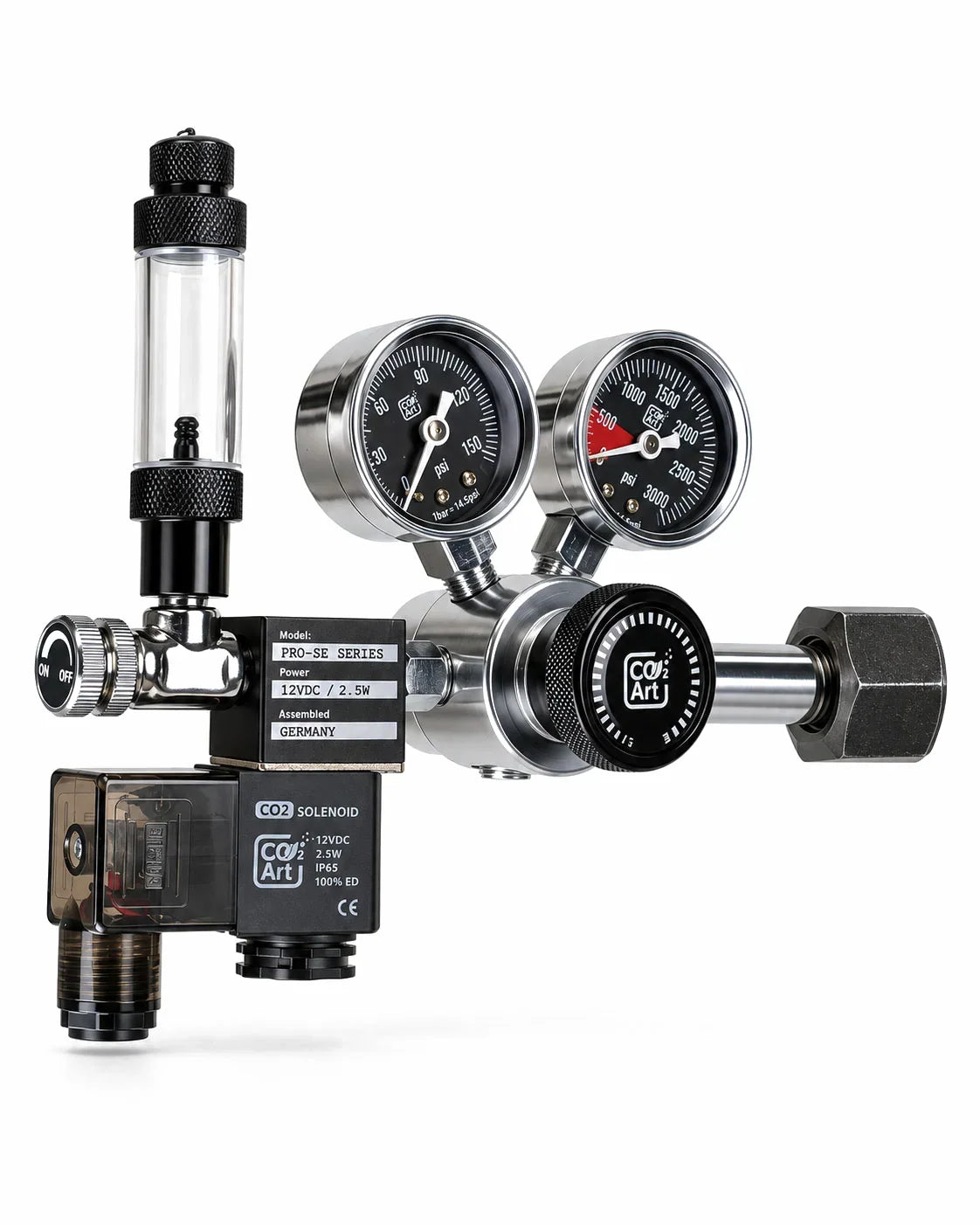
A reactor is forgiving about how much working pressure it needs, but it is not forgiving about pressure that wanders. A dual stage regulator holds the same working pressure as the cylinder empties, so a bubble rate you set this month still means the same thing next month. Our inline and in-tank diffusers state a minimum working pressure on their own pages — 30 PSI — and a reactor that follows a sagging regulator will drift the same way whatever its own requirement is.
Measuring what you can no longer see
With no mist in the tank, the bubble counter and the drop checker are your eyes. Set the gas by the counter, then let a drop checker tell you where the water actually sits, reading its colour against the chart rather than guessing from the bubbles. Give it hours, not minutes, before you judge a change; the colour to aim for with the reference fluid is green.

Common CO2 reactor problems and how to avoid them
Nearly every reactor complaint comes back to gas or flow: too much gas for the water passing through, or too little water for the gas. The fixes are mostly free.
- Gurgling and burping: gas is arriving faster than the chamber can dissolve it. Lower the bubble rate, mount the unit the way its instructions show, and purge the pocket.
- Flow that fades over weeks: open the chamber and rinse it out. Debris carried from the filter collects inside and takes the flow with it.
- A slug of gas at lights-on: let the solenoid open only with the filter already running, never before it.
- Water on the cabinet floor: inline fittings work loose as hose goes stiff. Replace CO2-rated tubing when it hardens, and fit a precision check valve so a stopped filter cannot push water back toward the regulator.
- Algae inside the chamber: it is dark, wet and rich in gas in there. A rinse at every filter service keeps it in check.
- The silent failure: the counter keeps counting, the chamber keeps its pocket, and nothing dissolves. If the plants pearl less and the drop checker drifts, suspect the reactor before the fertiliser.
Does a reactor fix CO2 that will not dissolve?
Usually not. The common reason a planted tank reads low on CO2 is not the dissolving device but what feeds it: working pressure that sags as the cylinder empties, a bubble rate set once and never checked, tubing that has begun to weep, or circulation that leaves half the tank standing still. A reactor plumbed onto those problems hides them, because it removes the one symptom you could actually see.
This is also where we should be straight with you: CO2Art does not make a reactor. We make regulators, inline and in-tank diffusers and complete kits, so read the pros above as a fair account of the alternative rather than a pitch. If your gas is unstable, start with a dual stage regulator with an integrated solenoid and a drop checker; if the mist in the water is what bothers you, an inline diffuser on the filter's outflow is a shorter route to clear water than a chamber under the tank.
Frequently asked questions
What are the pros and cons of a CO2 reactor?
The pros: almost all of the gas dissolves, nothing is visible in the tank, and there is no ceramic to clog. The cons: it costs you filter flow, it can trap gas and gurgle, it adds joints that can leak, and it gives you no visual sign that CO2 is flowing.
Is a CO2 reactor better than a diffuser?
Not in every tank. A reactor wastes less gas and keeps mist out of the water, which suits large planted displays. A diffuser is simpler, shows you at a glance that gas is moving, and costs the filter almost nothing in flow. Your tank, your filter and your tolerance for plumbing decide it.
Does a CO2 reactor reduce filter flow?
Yes. The chamber and its media sit in the return line, so part of the filter's output goes into pushing water through them. Plan for it: choose a filter with flow to spare, keep the chamber clean, and check circulation in the tank after fitting rather than assuming the plants will cope.
Why does my CO2 reactor gurgle?
Gas is collecting faster than the chamber can dissolve it, so a pocket forms at the top and escapes in bursts. Lower the bubble rate, mount the unit as its instructions show, make sure the filter moves enough water through it, and purge the trapped gas.
Do I need a CO2 reactor for a large planted tank?
No, though it is a fair choice there. Large tanks are where a reactor's efficiency and clear water show best. An inline diffuser on a strong canister filter also serves a big display, and it is easier to fit, easier to clean and easier to read at a glance.
If you would rather dissolve CO2 on the filter's outflow without a chamber to burp at you, our complete aquarium CO2 systems pair a dual stage regulator with an inline diffuser in one box.

Share:
Where to Buy a CO2 Cylinder for a Planted Aquarium (US Guide)