

You buy a CO2 cylinder locally, not online: a filled, pressurized cylinder is awkward and expensive to ship, so almost every planted-tank keeper in the US gets one from a welding, beverage or fire-equipment supplier and keeps refilling it. The cylinder is the only part of a pressurized CO2 setup you source yourself. Everything that screws onto it you buy once.

Where to buy a CO2 cylinder
Four kinds of business sell or fill carbon dioxide cylinders in most American towns: industrial and welding gas suppliers, beverage and homebrew gas dealers, fire-extinguisher service shops, and paintball or sporting-goods stores. They all sell the same gas. What differs is the sizes they stock, whether the cylinder becomes yours, and how far you have to drive to get it filled again.
Search for the trade, not for the hobby. A welding supplier has no idea what a planted tank is and does not need to; ask for a carbon dioxide cylinder and a fill, and you will be served like any other customer. Aquarium shops rarely stock cylinders, and online retailers ship them empty, because a filled cylinder travels as hazardous goods.
That last point decides the order of your shopping. An empty cylinder bought online still has to be filled somewhere near you, so find the filling station before you buy the bottle. If the only supplier within reach swaps cylinders rather than refilling them, that alone decides which cylinder is worth owning.
Does CO2Art sell CO2 cylinders?
No, and it is worth saying plainly. We build the hardware that sits on top of the cylinder, from CO2 regulators to diffusers, tubing and complete systems, and we ship that anywhere. A filled cylinder cannot travel that way. The gas is a local purchase everywhere in the world, and your supplier's refill price shapes the running cost of a planted tank far more than anything we sell.
| Where you go | What you come home with | Valve thread | What to check first |
|---|---|---|---|
| Industrial or welding gas supplier | A filled aluminum or steel cylinder, bought or leased | CGA320 | Whether the cylinder becomes yours or stays theirs |
| Beverage or homebrew gas dealer | A food-grade fill, often while you wait | CGA320 | That the cylinder has no siphon tube for liquid CO2 |
| Fire-extinguisher service shop | Refills, and sometimes a used cylinder for sale | CGA320, but confirm it | The stamped test date and whether a tube is fitted |
| Paintball or sporting-goods store | A small bottle for a nano tank or a stand-in | Paintball thread, adapter needed | That someone nearby fills them, not just sells them |
| SodaStream exchange point | A swapped bottle with no waiting | SodaStream thread, adapter needed | That your bottle type is accepted for exchange |
| Online marketplace | An empty used cylinder, shipped to you | Read it off the listing photos | The stamped test date and who locally will fill it |
Buy, lease or exchange: who owns the cylinder
Three arrangements are common, and a price only makes sense once you know which one you are being offered. In an outright purchase the cylinder is yours: the supplier empties it, fills it and hands the same one back. In a lease you pay a recurring fee and never own it. In an exchange you leave a bottle on the counter and walk out with a different filled one, which is fast, but means your new cylinder can come back as a scratched one.
For a planted tank, owning the cylinder usually ends up cheapest, because a fill costs a fraction of a lease over the years and you stay free to change suppliers. Exchange suits anyone who would rather not leave a cylinder behind for a day. Leasing mostly suits workshops that want no responsibility for testing. Ask which of the three it is in those words, and ask what a fill costs on its own, before you agree to a size.
What size CO2 cylinder should you buy?
Bigger is cheaper per fill and heavier to carry, and that is most of the decision. A large cylinder also buys months between trips to the supplier, which matters more than it sounds when the shop is across town and closes early. The practical ceiling is what fits under the tank, or beside the cabinet, standing upright and strapped in place.
Cylinders are sold by weight of gas in the US, so ask the supplier which sizes they actually stock and fill; the usual steps are 2.5 lb, 5 lb, 10 lb and 20 lb. Our own guide to what size CO2 cylinder to get works through tank size and plant density. The short version: the smallest size a local supplier will fill serves a nano or desk tank, and a long display tank justifies the step up simply to cut the number of refill trips.
How long a fill lasts is a separate question, driven by the tank, the light, the bubble rate and the diffuser, and we cover it in how long a refillable CO2 cylinder lasts. Treat any figure as a starting point and watch your own drop checker.
New or used: what to read on the cylinder before you pay
A used cylinder is a sound buy when its history is stamped in the metal. Around the shoulder you will find the specification it was built to, a serial number, and a date: the last time it passed its pressure test. A requalification date that has run out does not make a cylinder scrap, but no supplier will fill it until it has been retested, and that costs money and a wait. Read the date before you hand over cash, and know the interval allowed, which is 5 years.

Then ask the question that catches people out: does it have a siphon tube? Some beverage cylinders are fitted with a dip tube so they deliver liquid carbon dioxide, which is what a soda fountain wants and the last thing you want arriving at an aquarium regulator. For a planted tank you want vapor withdrawal, meaning gas drawn from the top of an upright cylinder with no tube inside.
Aluminum or steel is a question of taste and back strain. Aluminum is lighter, will not rust inside if moisture ever gets in, and usually costs more new. Steel is cheaper, shrugs off knocks, and is noticeably heavier in the same size. Both take the same valve, so your regulator does not care which you choose.
Will it fit your regulator? The valve thread
In the United States, carbon dioxide cylinders carry the CGA320 valve outlet, and that is the thread an aquarium regulator is built for; ours are, so a cylinder from a welding or beverage supplier screws straight on with its washer. Confirm the outlet anyway when you buy used or imported, because a cylinder that spent its life in a fire extinguisher, or came from Europe, may carry something else entirely.
Small bottles are the exception. Paintball cylinders and SodaStream bottles use their own threads, so a paintball and SodaStream adapter goes between the bottle and the regulator and presents the CGA320 thread the regulator expects. That route suits a nano tank, or a stand-in while your main cylinder is away for a fill, and it lets you buy gas at a sporting-goods counter.
One small part deserves naming: the fiber washer at the cylinder joint. A flattened or missing replacement washer is the most common reason a cylinder quietly empties itself over a weekend, so fit a fresh one each time the regulator comes off the bottle.
What you need besides the cylinder
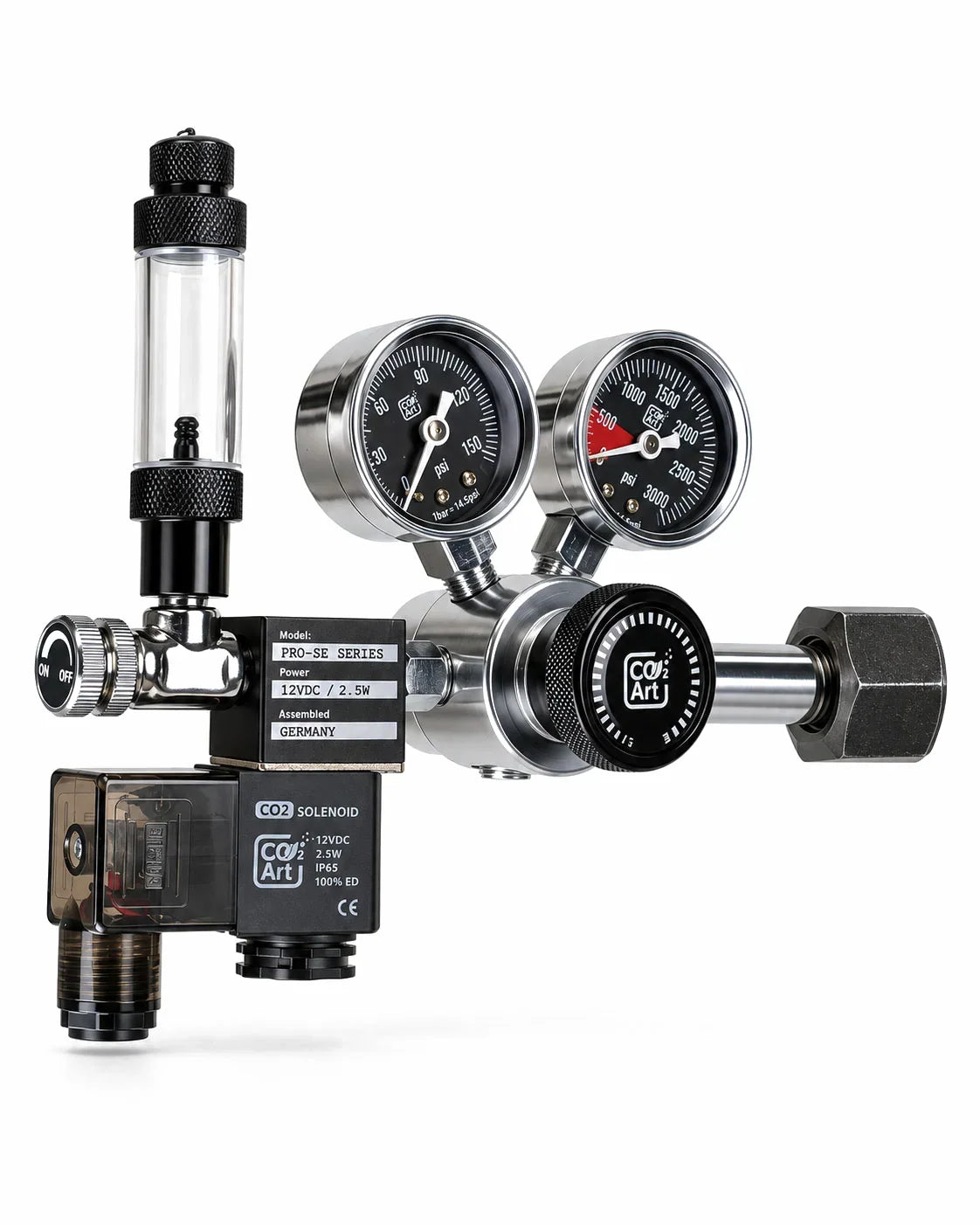
The cylinder is the one part we do not sell, and the only part that cannot arrive in a parcel. Everything downstream is a single purchase that lasts for years: a dual-stage regulator with a solenoid, so gas flows only while the lights are on; a bubble counter you can set by eye; a check valve, so water can never siphon back into the regulator; tubing rated for carbon dioxide; a diffuser in the tank or an inline atomizer on the filter return; and a drop checker, so you read the level in the water instead of guessing it.
If you are starting from nothing, a matched kit is less fiddly than assembling that chain from separate parts, and the fittings are known to suit each other. Order it while the cylinder is being filled and the whole system goes together in an evening.
Getting it home and running it safely
Carbon dioxide is not flammable, which makes a cylinder beside an aquarium far less dramatic than a propane bottle. The hazards are the stored pressure and, in a small closed room, gas displacing air. Both are managed by habits rather than equipment.
- Carry it upright in the footwell or strapped in the trunk, never loose on a seat, and do not leave it in a hot parked car.
- Stand it upright at the tank and strap it to the cabinet or a wall so it cannot tip; a falling cylinder can shear its valve.
- Open the cylinder valve slowly and then fully, and leave it there. Working pressure is set at the regulator, never at the bottle.
- Brush soapy water over the joint after every refill and watch for a bubble growing. That is the whole leak test.
- Keep it out of direct sun and away from heaters, and never paint, grind or weld anything attached to it.
- Shut the cylinder valve if you leave the tank for a long trip, and ventilate a small closed room where a cylinder lives.
Frequently asked questions
Does CO2Art sell CO2 cylinders?
No. We make the regulators, diffusers and complete systems that sit on top of a cylinder, and we ship those worldwide. A filled cylinder travels as hazardous goods, so the gas itself is a local purchase from a welding, beverage or fire-equipment supplier wherever you live.
Where can I buy a CO2 cylinder for an aquarium?
From an industrial or welding gas supplier, a beverage and homebrew gas dealer, a fire-extinguisher service shop, or a paintball store for the small bottles. Look up the trade rather than the aquarium hobby, and find out who fills cylinders near you before buying one.
Is it cheaper to refill or exchange a CO2 cylinder?
Refilling a cylinder you own is usually cheaper over the years, and you get the same bottle back. Exchange costs a little more and is quicker, but you swap your cylinder for whatever the shop has on the shelf. Ask which service your supplier actually offers.
Can I use a paintball or SodaStream cylinder instead?
Yes, with an adapter that presents the thread an aquarium regulator expects. It is a good answer for a nano tank, or as a stand-in while your main cylinder is being filled, though small bottles need swapping far more often than a full-size one.
What should I check before buying a used CO2 cylinder?
The stamped test date on the shoulder first, because no supplier will fill a cylinder whose requalification has lapsed. Then the valve outlet, and whether a siphon tube is fitted: an aquarium needs gas drawn from the top, not liquid carbon dioxide.
Once you know which cylinder you can get filled near you, our complete CO2 systems cover everything that screws onto it: regulator, bubble counter, tubing, diffuser and drop checker.
Sources
- U.S. DOT, 49 CFR 180.205 - Requalification of specification cylinders (eCFR)
- Compressed Gas Association - CGA V-1, standard for compressed gas cylinder valve outlet connections
- OSHA 1910.101 - Compressed gases, general requirements
- A local welding or beverage gas supplier's own price list and stock list
Share:
The Difference Between a Single Stage and Dual Stage CO2 Regulator