
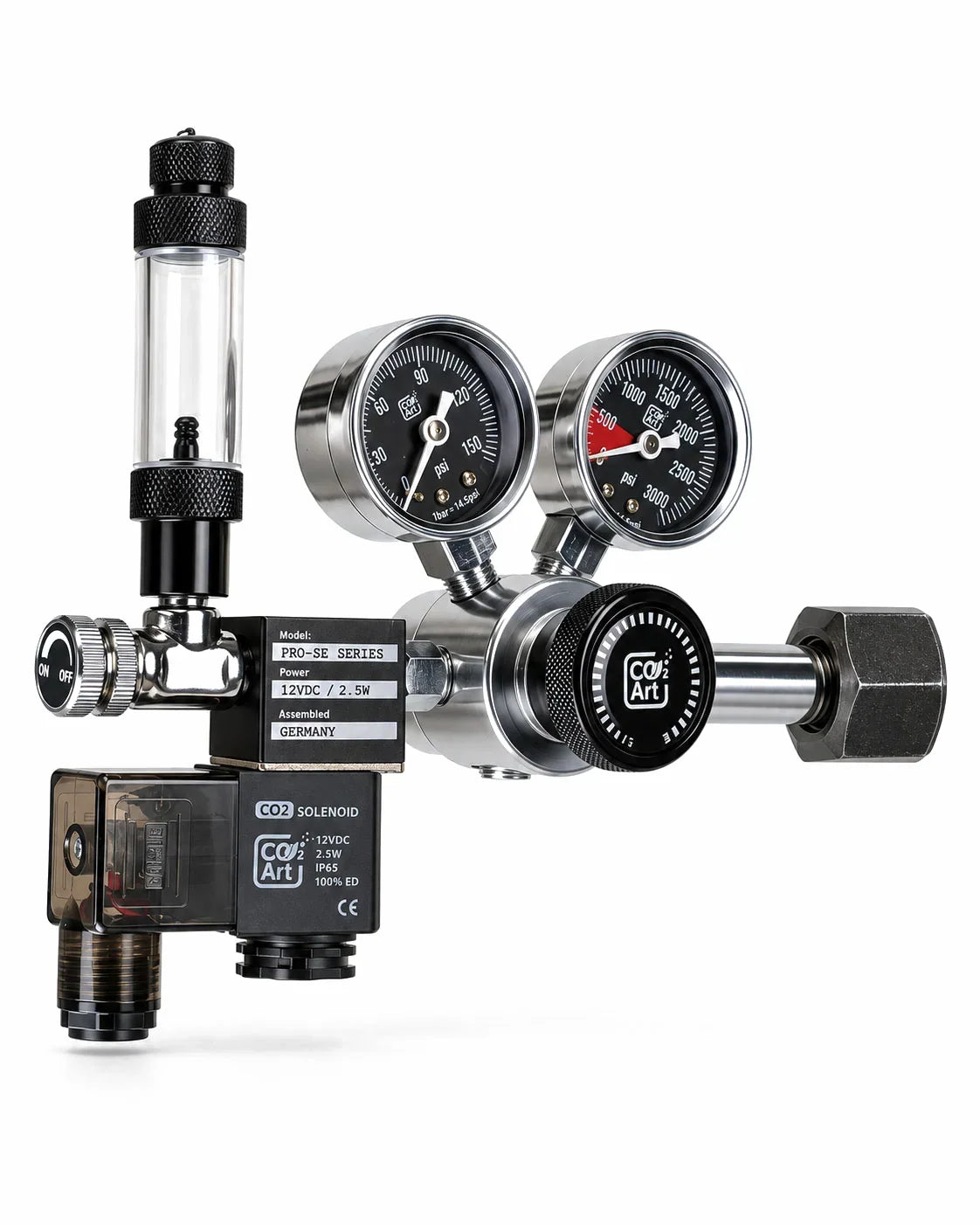
The difference between a single stage and a dual stage CO2 regulator is how many steps it uses to bring cylinder pressure down to working pressure. A single-stage regulator does it in one step, so its output drifts upward as the cylinder empties. A dual-stage regulator does it in two, holding the output near where you set it from a full cylinder to an empty one.
What does a CO2 regulator do?
A CO2 cylinder holds gas at a pressure far higher than anything you want near an aquarium. A regulator sits on the cylinder valve, brings that pressure down to a working pressure your diffuser or reactor can use, and then holds it there. The needle valve after it turns that steady pressure into a countable bubble rate, and the solenoid switches the gas on and off with your lights.
Stages describe only the first part of that job: how the drop from cylinder pressure to working pressure is made. It matters because everything downstream assumes the pressure feeding it stays where you left it. If that pressure creeps, the bubble rate creeps with it — and nobody is standing at the tank to notice.
What is the difference between a single stage and a dual stage regulator?
A single-stage regulator makes the whole reduction in one step. A dual-stage regulator makes it in two, with a sealed intermediate pressure in between. Both can hold a pressure accurately on a bench with a fresh cylinder. The difference shows up over weeks, as the cylinder empties and the pressure feeding the regulator falls.
How a single-stage regulator behaves
The single spring-and-diaphragm assembly inside is balanced partly against the cylinder pressure pushing on it. As the cylinder empties, that inlet force falls, the balance shifts, and the outlet pressure drifts — in a CO2 regulator, upward. Engineers call it supply pressure effect. In a planted tank it looks like a bubble rate you set carefully when the cylinder was new and find faster weeks later, with the drop checker a shade more yellow than you wanted.
How a dual-stage regulator behaves
A dual-stage body does the reduction twice. The first stage drops cylinder pressure to a fixed intermediate pressure and holds it there; the second stage works from that intermediate pressure instead of from the cylinder. Because the second stage sees roughly the same inlet pressure whether the cylinder is full or nearly spent, its outlet stays near where you set it. Our own Pro-SE dual-stage regulator with integrated solenoid is built that way, and its page puts it plainly: the design minimises any rise in output pressure as pressure drops in the cylinder.
| Single-stage regulator | Dual-stage regulator | |
|---|---|---|
| Steps from cylinder pressure to working pressure | One | Two |
| Output pressure as the cylinder empties | Drifts upward | Stays near where you set it |
| Bubble rate over a cylinder's life | Needs re-trimming | Holds between refills |
| End-of-tank dump | A real risk as the last gas goes | Designed out |
| How much watching it needs | Regular checks, especially late in a cylinder | Routine checks |
| Gauges on the body | Often a pair — gauges are not stages | Often a pair |
| Best suited to | A tank you watch closely | A stocked tank that runs unattended |
What is end of tank dump, and does a dual stage regulator prevent it?
An end-of-tank dump is the surge of CO2 some setups deliver as a cylinder gives up its last gas. While there is still liquid CO2 inside, the pressure above it stays roughly constant however much is left — which is why a CO2 cylinder's high-pressure gauge is a poor fuel gauge. Once the last liquid has boiled off, only gas remains, and cylinder pressure falls away quickly.
In a single-stage regulator that collapse is exactly the condition that unbalances the spring, so the outlet pressure can rise just as the gas runs out. The bubble rate climbs, the drop checker turns yellow, pH falls, and the fish are the first to tell you. It happens at night as readily as in the afternoon, and it happens on the cylinder nobody thought to weigh.
A dual-stage regulator is designed out of that failure. The first stage absorbs the falling inlet pressure, so the second stage keeps feeding the needle valve at the pressure you set until the cylinder is genuinely empty — and then the bubbles simply stop. That is the behaviour you want from a device that runs unattended, though a drop checker is still what tells you where the tank actually stands.
Dual stage is not the same as dual gauge
This is the confusion worth clearing up before you spend anything. The gauges on a regulator body report pressure: one reads what is left in the cylinder, the other reads the working pressure going out to the tank. Having a pair of them says nothing at all about how many reduction steps are inside the body.
Plenty of single-stage regulators carry two gauges, and listings describe them as dual gauge, twin gauge, or loosely as two-stage when they mean two dials. Read the description for the word stage used about the reduction itself, and if it is not there, assume one step until the maker says otherwise. On our CO2 regulators the dual-stage claim is about the construction, and the gauges are described separately.
Which do you need for a planted aquarium?
If the tank is planted, stocked, and injecting all day while you are at work, the steadier device is the one to own. A dual-stage regulator removes a whole class of problem — the slow drift and the end-of-cylinder surge — without asking you to check anything to do it.
A single-stage regulator is not useless. With a precise needle valve, a cylinder you weigh or replace early, and a drop checker you actually look at, people run them for years. The cost is attention: you re-trim the bubble rate as the cylinder empties, and you treat the end of a cylinder as the risky part. On a shrimp tank or a heavily stocked display, that is a lot of trust to place in a habit.
Either way, the stage count is one line in a longer decision. Our buying guide for planted-tank regulators walks through the rest — body and seals, solenoid, needle valve, cylinder fitting, warranty — against the models we sell.
What matters as much as the stages
Stage count is the part of a regulator people argue about, but it is not the only thing that decides whether a CO2 setup is calm or fiddly. When you compare two regulators, compare these too.
- A solenoid built into the body rather than hung off it: one body, one seal, one thing to fail — and it switches the gas with your light timer.
- A needle valve made for small, repeatable adjustments. A tap you nudge is not a needle valve.
- A bubble counter you can read from across the room, so a drift shows up before the livestock does.
- A precision check valve in the line, so water never travels back toward the gas.
- The cylinder fitting used where you live. North American and European cylinder threads are not interchangeable, and an adapter is a part you choose deliberately, not a bodge.
- Gauges that stay readable and parts you can still buy in a few years — a regulator outlives most of the rest of the setup.
How can I tell whether my regulator is single or dual stage?
Look for the word stage in the maker's own description of the reduction, not in the gauge count. A dual-stage body is usually described as holding output steady as the cylinder empties, and it tends to be deeper and heavier for the extra chamber it carries. If a listing only says dual gauge, treat it as a single-stage regulator.
Then test it rather than trust it. Note the working pressure and the bubble rate with a fresh cylinder, write them down, and look again when that cylinder is close to spent. A reading that has not moved is a dual-stage regulator doing its job. A reading that has climbed is a single-stage regulator telling you to watch the last of the gas closely — or to change the device.
Frequently asked questions
Is a dual stage CO2 regulator worth it on a planted tank?
If the tank runs unattended and holds livestock, yes. A dual-stage body holds the working pressure steady as the cylinder empties, so the bubble rate you set is the bubble rate you keep, and the end of a cylinder stops being an event you have to catch.
Can I use a single stage regulator for aquarium CO2?
You can, with a precise needle valve and the habit of checking. Expect the output to drift upward as the cylinder empties, so re-trim the bubble rate, watch the drop checker, and replace the cylinder before it runs completely dry.
What is an end of tank dump?
It is the surge of gas that can come as a cylinder's last liquid CO2 boils off and cylinder pressure falls away. A single-stage regulator can let its own output rise at that moment, pushing the bubble rate up when nobody is watching the tank.
Is a dual gauge regulator the same as a dual stage regulator?
No. Gauges report pressure, stages reduce it. A dual gauge regulator shows cylinder contents and working pressure and may still make the whole reduction in one step. Look for the word stage used about the reduction itself, not about the dials.
Does a dual stage regulator still need a solenoid and a check valve?
The stages handle pressure, not switching or backflow. A solenoid turns the gas off with your lights; a check valve keeps water out of the gas line. Our regulators carry the solenoid in the body, and the check valve sits in the line to the tank.
If a bubble rate that holds from a full cylinder to an empty one is what you are after, that is what the dual-stage design in our CO2 regulators and complete CO2 systems is for.
Share:
Bad CO2 Bubbles: Why Your Diffuser Mist Isn't Reaching Plants