
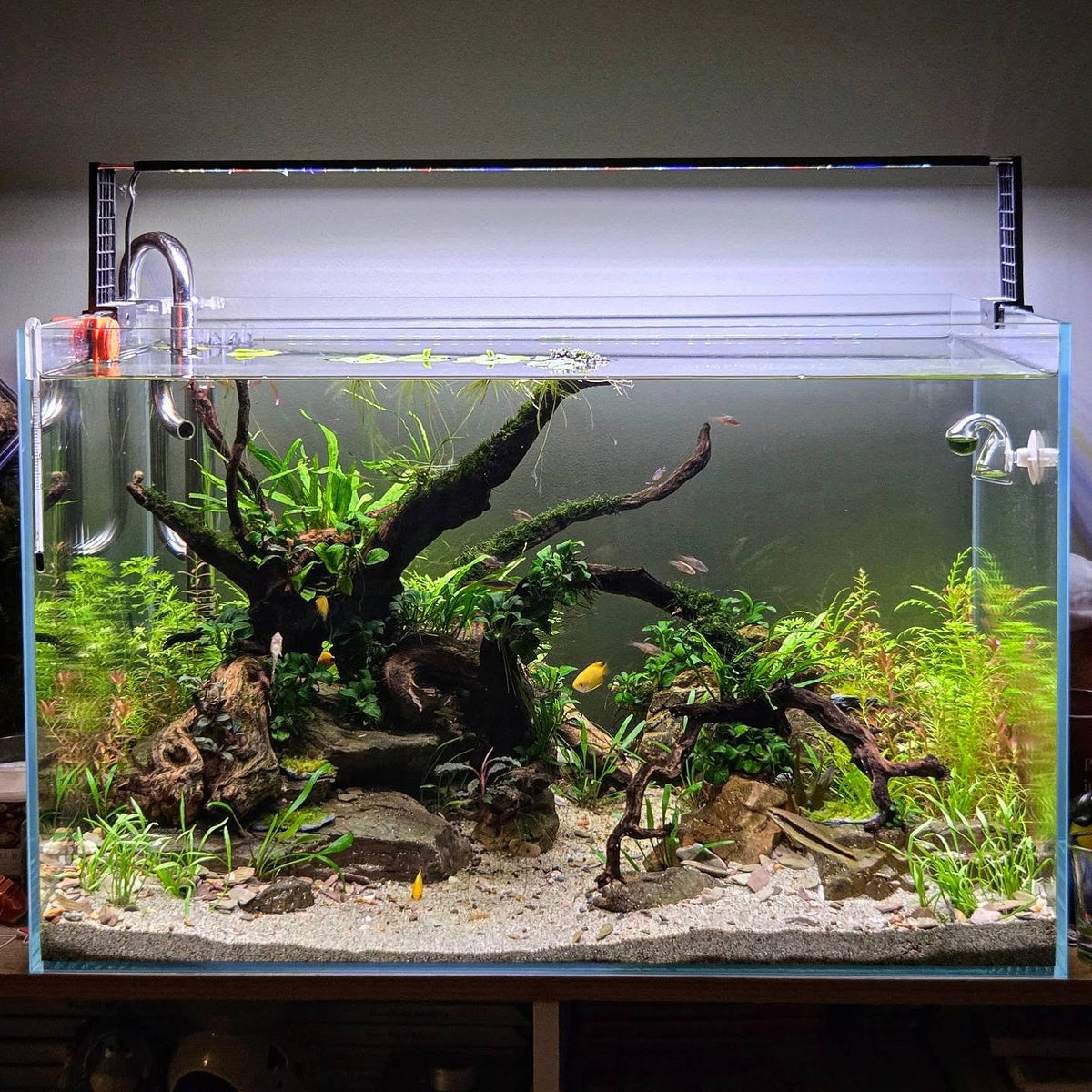
The CO2 system for a 20 gallon aquarium is a pressurized kit: a dual stage regulator with a solenoid, a bubble counter, a diffuser matched to the tank, a drop checker and CO2-resistant tubing, plus a cylinder you fill locally. Tank volume decides the diffuser and the cylinder, not the regulator — the same regulator serves a 20 gallon or a 75 gallon tank, and only the dose and the refill interval change.
What a CO2 system for a 20 gallon aquarium includes
Our complete CO2 systems ship as five parts: a dual stage regulator with an integrated solenoid, an aluminum bubble counter, a diffuser, a drop checker with indicator solution, and CO2-resistant tubing. The cylinder is not in the box. You buy it where you can have it refilled — a welding supplier, a beverage gas supplier, a fire equipment shop — and stand it in the cabinet under the tank. Everything else in the kit is the same hardware whether the tank holds 20 gallons or 75.
The regulator is the part people expect to size up, and it is the part that does not care how big the tank is. A dual stage regulator with an integrated solenoid holds its working pressure steady as the cylinder empties, which is what stops the end of tank dump that can empty a bottle into the water overnight. The solenoid is the other half of that job: it cuts the gas when the lights go off, so the tank is not being dosed while the plants are asleep.
One thing to check before you order is the fitting. In North America a CO2 cylinder valve takes the CGA320 connection, so that is the regulator inlet you want on this store. If the cylinder came from somewhere else, read the markings on its valve first — an adapter is a small part, a wrong regulator inlet is a return.
What changes with tank size — and what does not
Sizing a CO2 system is mostly about two things: getting the gas to dissolve evenly through a larger body of water, and not walking to the filling station every other week. The regulator, the bubble counter and the drop checker are the same on every tank in this guide. What changes is the diffuser you choose, the cylinder you put behind it, and how patiently you raise the dose once the system is running.
- Diffuser type: an inline unit when the tank has an external canister filter, an in-tank unit when it does not.
- Diffuser capacity: each model states the tank volume it comfortably serves.
- Cylinder size: the bigger the tank, the sooner the same bottle empties. Match it to the height under the cabinet and to how far you travel for a refill.
- Circulation: CO2 follows the flow. A long 55 gallon or 75 gallon tank needs the outflow aimed so the far end is not left starved.
Inline or in-tank: choosing the diffuser
This is the one decision set by your filter rather than by your tank size. Both styles dissolve the same gas; they differ in where the mist is made and how much hardware you look at in the water.
Inline diffusers for tanks with an external filter
An inline diffuser sits in the hose of a canister filter, outside the tank, and pushes a fine mist into the return flow. Nothing but the hose is visible, the filter's own current spreads the gas through the tank, and the glassware stays out of the way when you clean. It is the usual choice from a 30 gallon tank upward, because that is the size at which most keepers already run a canister.
In-tank diffusers for tanks without a canister
If the tank runs a hang-on-back filter or a sponge, the gas has to go in through the glass. An in-tank diffuser mounts low on the back wall and releases mist that the flow carries across the plants. Put it on the opposite side from the outflow so the bubbles travel the length of the tank before they surface — that is most of the trick on aquariums with internal filtration.

CO2 system by tank size
Here is the short version, size by size, with the table at the end of the section collecting it. Treat each one as a starting point for a planted tank under moderate light, then let the drop checker and the plants correct you. A carpet under bright light will want more gas than the same volume of slow growers.
A 20 gallon aquarium
A 20 gallon tank is small enough that either diffuser style works, and big enough that a proper regulator earns its place. Most keepers run an in-tank diffuser here, with a small refillable cylinder in the cabinet. If there is no gas supplier near you, our adapter for paintball and SodaStream bottles will run a tank this size while you sort out a refill. Start low and add gas over several days.
A 30 gallon aquarium
At 30 gallons the tank is usually deeper and longer, and a canister filter is common — which makes an inline diffuser the tidier answer. The hardware does not change from a 20 gallon setup; the cylinder does. A bottle that lasted a season on the smaller tank will come up short here, so plan on the next cylinder size up rather than on more trips.
A 55 gallon aquarium
A 55 gallon tank is long and narrow, and that shape decides the install: an inline diffuser in the canister hose, with the return aimed along the length so the mist reaches the far end. This is the size at which the refill trips start to matter and a larger refillable bottle stops being optional.
A 75 gallon aquarium
A 75 gallon tank needs the gas spread, not only increased. An inline diffuser on a strong canister is the base; if the far end still runs lean, add flow before you add bubbles. Expect a shorter run between refills than a smaller tank gave you, and keep the drop checker where you can read it from the front.
| Tank size | CO2 system type | Starting bubble rate (bubbles per second) |
|---|---|---|
| 20 gallon | Complete kit with an in-tank diffuser; inline instead when a canister filter is fitted. A paintball or SodaStream bottle can be used | one bubble every 5 seconds |
| 30 gallon | Complete kit with an inline diffuser once a canister filter is on the tank; refillable cylinder rather than a disposable | one bubble every 3 seconds |
| 55 gallon | Complete kit with an inline diffuser in the canister hose; return aimed along the length of the tank. | one bubble per second |
| 75 gallon | Complete kit with an inline diffuser and strong flow | two bubbles per second |
Which cylinder, and how often you will refill it
The cylinder is the part tank size really drives, and the part we do not ship with the kit. Two things set the choice: how much room there is under the cabinet, and where you refill. We wrote a longer piece on it — what size CO2 cylinder should I get for my aquarium — and the short version is to buy one size larger than the tank seems to need, because the cost per fill falls and the trips get rarer.

Aluminum bottles are lighter and slide under a cabinet more easily; steel is the cheaper bottle to find second hand and the heavier one to carry. If nothing local fills aquarium cylinders, our adapter for paintball and SodaStream bottles takes the CGA320 thread on the regulator and turns a bottle you can buy anywhere into a working supply for a small tank.
The most important part about choosing the right CO2 cylinder for your aquarium is the quality of gas. Look for food-grade cylinders with pure carbon dioxide to ensure the longevity of the CO2 system.
Set the dose with the drop checker, not the bubble count
Bubbles per second is the figure everyone asks for and the one least worth copying from an article. A bubble's size depends on the counter, the working pressure and the tubing, so the same count is not the same dose on two tanks. Use it as your own repeatable setting, written down once the tank is stable — not as a target taken from someone else's aquarium.
The drop checker closes the loop: filled with indicator solution, it reads the dissolved gas and settles on a color you can check from across the room. Green is the working range, blue means add gas, yellow means cut back now. Raise the rate a little every few days and give the water a full day to answer before you judge it.
Run the solenoid from the same timer as the lights: gas on before the lights come up, off before they go down. The lead time that suits most aquariums is about 8 hours a day — find it once, then leave it alone.
Frequently asked questions
What CO2 system do I need for a 20 gallon aquarium?
A complete pressurized kit: a dual stage regulator with a solenoid, a bubble counter, a diffuser, a drop checker and CO2-resistant tubing, plus a refillable cylinder bought locally. Either diffuser style works on a tank this size; choose the inline one when a canister filter is already on the tank.
Do I need a different regulator for a 55 gallon aquarium?
No. The regulator is the same on a 20 gallon and a 55 gallon tank — it holds pressure steady and switches the gas, and neither job scales with volume. What changes is the diffuser, the cylinder size and the dose you settle on.
How many bubbles per second does a 30 gallon aquarium need?
There is no honest single figure, because bubble size differs between counters and working pressures. Start low, raise the rate every few days, and let the drop checker decide: green is the working range. Write down the count that holds green on your tank and use that as your setting.
What size CO2 cylinder suits a 75 gallon aquarium?
Larger than the tank seems to ask for, and limited by the cabinet. A bigger tank dissolves more gas each day, so the same bottle empties sooner. Measure the height under the tank, ask a local supplier which sizes they fill or exchange, then take the largest that fits.
Can I run a CO2 system without a drop checker?
You can, but you are dosing blind. Without it the first sign of too much gas is the fish gasping at the surface, and the first sign of too little is slow growth noticed weeks later. That is why the drop checker is in our complete kits.
Once you know the tank size and whether a canister filter is on it, the matching kit is one choice away in complete CO2 systems — or tell us the aquarium size and what you grow, and we will size it with you.
Share:
Aquarium Snails: Pest or Beneficial?