
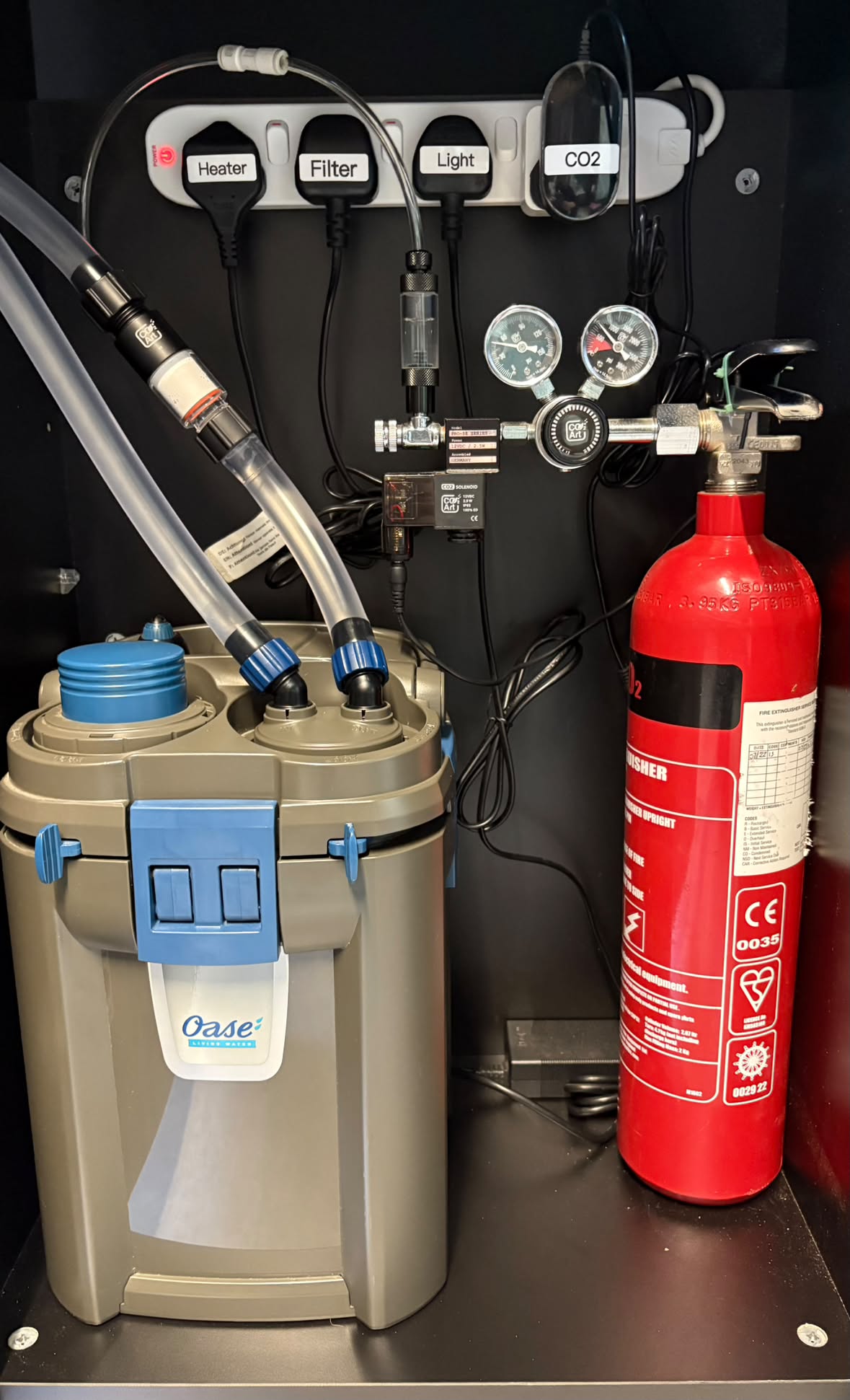
A CO2-proof, resistant special system is a carbon dioxide setup in which every part that holds pressure or touches the gas was built for it: a metal dual-stage CO2 regulator, a pressure-rated check valve, tubing the gas cannot seep through, and seals that carbonic acid will not attack. Borrowed air-pump parts leak, creep off their barbs, or stick — usually while nobody is watching.
What makes a CO2 system CO2-proof and resistant?
The phrase covers several different jobs. CO2-proof means the gas cannot escape where it is not wanted: through the wall of a tube, past a fitting, or back up the line when the solenoid shuts. Resistant means the materials survive what the gas does to them, because carbon dioxide dissolved in water makes a weak acid and that acid works on cheap metals and the wrong rubber. Special means the parts were designed for pressurised service instead of being borrowed from an air pump.
The practical test needs no tools. Follow the gas from the cylinder to the water and ask of every part whether its maker meant it to hold pressure: the cylinder valve and its washer, the CO2 regulator body and its seals, the needle valve, the bubble counter, the tubing, the check valve, the diffuser. A single borrowed component sets the standard for the whole system, because gas leaves at the weakest point and nowhere else.
None of this is exotic. A planted tank runs at a modest working pressure, around 55 PSI on the working gauge for an inline diffuser and lower for an in-tank one, and the parts that hold it are ordinary industrial components: brass, stainless steel, polyurethane, nylon, ceramic. What makes them special here is that they were chosen for carbon dioxide rather than for the lowest shelf price.
Why ordinary airline parts fail on a pressurised gas line
Most failures are not dramatic. The color on the CO2 drop checker drifts the wrong way, or a cylinder that should last months empties over a weekend, and the owner traces it to a part that was never meant for the job.
Silicone tubing lets the gas through its wall
Soft silicone airline is the usual culprit, and it is easy to see why people reach for it: it bends into place and pushes onto any barb. Silicone is also permeable. Carbon dioxide passes slowly through the wall along the entire run, so the loss grows with every extra foot between the cylinder and the tank, and it never announces itself as a hiss. Polyurethane tubing made for this gas is stiffer, far less permeable, and it keeps its grip on a barb instead of relaxing into a slow weep.
Air-pump check valves are not pressure parts
The small molded valve on an air pump exists to stop a siphon reaching the pump when the power cuts. It is a low-pressure part with a light diaphragm, and on a gas line it either leaks the wrong way or sticks shut. When it fails open, water travels back up the tubing to the needle valve and the CO2 regulator, and that repair costs many times what the valve ever did.
The wrong washer, and the wrong metal
Between the cylinder valve and the CO2 regulator sits a washer most people never think about, and it is the most common source of a hiss. It is a wear part: it seals by being crushed, so a flattened washer that has already done a refill will not seal again. Aluminum and zinc adapters bought to save a little money pit and corrode where condensation and acid collect. Brass and stainless steel do not.
| Part of the line | The borrowed version | What goes wrong | The resistant choice |
|---|---|---|---|
| Tubing | Soft silicone airline | The gas seeps through the wall and the tube creeps off its barb | Polyurethane tubing made for this gas |
| Non-return valve | Plastic air-pump check valve | Passes or sticks under pressure; water reaches the regulator | A precision CO2 check valve with a pressure rating |
| Cylinder seal | The washer already in the fitting | Crushed once and reused, it hisses at the joint | A fresh washer of the right material at every refill |
| Pressure control | Single-stage or unspecified regulator | Output drifts as the cylinder empties, ending in a dump | A dual-stage CO2 regulator with a metal body |
| Gas into water | An air stone | Coarse bubbles, poor dissolution, early clogging | A ceramic CO2 diffuser, in-tank or inline |
| Fittings and adapters | Aluminum or zinc | Pitting and corrosion where damp and acid collect | Brass or stainless steel |
The resistant parts a special CO2 system is built from
A system built to resist the gas is not a long shopping list. It is the same handful of parts as any other setup, each in its pressurized version.
A dual-stage CO2 regulator
The regulator decides whether everything downstream has an easy life. A single-stage unit drops cylinder pressure to working pressure in a single step, so its output wanders as the cylinder falls: the familiar end-of-tank dump, which arrives as a surge of gas at the worst possible moment. A dual-stage design does it in stages and holds working pressure steady almost to the last of the gas, so the bubble rate you set is the rate the tank keeps. The Pro SE Series dual-stage CO2 regulator with an integrated solenoid adds the part that turns the gas off with the lights.
A precision CO2 check valve
A check valve belongs in the line near the water, and it has to hold the full working pressure without sticking. A precision CO2 check valve is machined, sprung and sealed with a material chosen for the gas, which is what separates it from a molded air fitting. Fit it the right way round, with the arrow pointing toward the tank, and it keeps water out of the needle valve on every shutdown.
CO2-proof tubing, washers and the parts nobody photographs
Polyurethane tubing, a spare cylinder washer, a U-bend so the tube does not kink over the rim, suction cups, an inline bubble counter: these decide whether a system holds, and none of them photograph well. They sit in our CO2 accessories section, and a spare washer for the CO2 aquarium regulator costs almost nothing measured against an afternoon spent hunting a leak.
A CO2 diffuser that can take the pressure
Ceramic only works with pressure behind it, which is why a fine diffuser and a weak regulator make a poor pair. An in-tank ceramic unit is easy to watch and easy to clean. An inline unit such as the CO2Art inline aquarium atomizer sits in the filter return, out of sight, and breaks the gas into a mist the water takes up quickly. Either way the ceramic clogs with time and is cleaned rather than thrown away. 
How to tell a special CO2 system from a converted air kit
Catalog copy rarely uses the words CO2-proof or resistant, so read the parts list instead. A system designed for the gas talks about materials and pressure; a converted air kit talks about color and price.
- A metal regulator body, with a gauge for cylinder pressure and a gauge for working pressure
- Dual-stage pressure control stated in the specification, not just a pair of dials on the face
- A needle valve with a fine, repeatable thread rather than a thumb wheel
- Tubing described as polyurethane or sold for this gas, not generic airline
- A check valve given a working pressure rating
- The cylinder washer listed as a wear part, with spares available
- A diffuser that states the pressure it needs to work
Leak-testing and keeping a resistant CO2 system tight
Test the joints when the system is new, and again after every refill. Close the needle valve, open the cylinder, read the working gauge, then shut the cylinder valve and leave it alone. A reading that has fallen by morning means gas is escaping somewhere, even when nothing can be heard.
- Brush soapy water onto each joint and watch for bubbles that keep growing
- Hand-tighten the cylinder nut, then bring it up with a wrench: hard enough to seal, not hard enough to deform the washer
- Replace the cylinder washer at every refill and keep spares with the cylinder
- Push tubing fully onto its barb, and route it so it cannot be tugged
- Watch the CO2 drop checker daily for the first week after any change
A complete CO2 system, or parts bought one at a time?
Both routes are honest. Buying part by part lets you keep a regulator you trust and change only the diffuser, and it is how most long-running tanks end up configured. It also puts the fitting questions on you: the thread, the barb, which washer, whether the check valve holds your working pressure.
A complete system removes those questions. The regulator thread matches the cylinder it was sold for, the tubing fits both barbs, the check valve is the one the kit was tested with, and the spares are listed in the same place. For a first pressurized setup that is usually cheaper than the parts sent back after a mismatch.
If a paintball or soda cylinder is what you can refill locally, the fitting question returns in another form. Our CO2 adapters cover the common threads, and the regulator still does the pressure work, but check what your local filler accepts before you buy the cylinder.
Frequently asked questions
Can I use silicone airline tubing for a CO2 system?
You can, and many people do until they start chasing a leak. Silicone is permeable, so carbon dioxide seeps through the wall along the whole run, and soft tubing relaxes off its barbs. Polyurethane tubing sold for this gas holds both the pressure and its grip.
What does a CO2 check valve actually protect?
It stops water siphoning back up the line when the solenoid closes or the cylinder empties. Without it, water reaches the bubble counter, the needle valve and eventually the CO2 regulator, corroding the parts that set your bubble rate.
Why does the cylinder washer need replacing at every refill?
It seals by being crushed. Once flattened it has no give left, so a joint that was tight before the refill hisses after it. Washers are cheap wear parts, and keeping spares beside the cylinder saves the hunt for a leak that is not really there.
Is a dual-stage CO2 regulator worth it on a small tank?
Its value is steadiness rather than size. A dual-stage unit holds working pressure as the cylinder empties, so the bubble rate you set is the rate you keep and there is no end-of-tank surge. On a small tank a surge does proportionally more harm.
Does carbon dioxide corrode aquarium equipment?
Dissolved carbon dioxide makes a weak acid, which is why metal choice matters at the wet end of the line. Brass, stainless steel and ceramic cope with it. Aluminum and zinc fittings pit where condensation collects, so check the material list before buying an unbranded adapter.
If you would rather not audit every fitting yourself, our complete CO2 systems arrive matched — regulator, check valve, tubing and diffuser that were tested together.


Share:
CO2 Reactor Pros and Cons for Planted Aquariums